


"KOSPI Sheds 14.5% in a Week as Circuit Breakers Trip — Hot Inflation and AI Debt Fears Hammer Chipmakers"
Hotter-than-expected September CPI and PPI readings, combined with mounting worries over debt-funded AI infrastructure, sent the Nasdaq down 4.48% for the week. Korea's chip-heavy KOSPI fared far worse, plunging 14.46% after a market-wide trading halt on Thursday. This week, Tesla and Meta earnings and Thursday's Bank of Korea rate decision will test whether the panic has found a floor.
Last week, inflation and AI financing fears erupted at the same time, and the selling converged on semiconductors.
Index Performance
The S&P 500 fell 1.95% on the week, from 7,811.54 to 7,659.44, while the Nasdaq Composite slid 4.48% to 26,140.03 from 27,366.17. The Dow bucked the trend, rising 0.67% to 52,002.41 from 51,654.95 for a second straight weekly gain (weekly changes calculated from prior-week closes). Inflation pulled the trigger. September CPI, released on the 14th, rose 3.7% year over year versus a 3.6% consensus, and core CPI climbed 0.33% month over month against expectations of 0.2% [1]. Gasoline, up 9.1% in a single month, did much of the damage. A day later, PPI jumped 1.3% month over month — more than double the 0.6% forecast — lifting the annual rate to 6.3% [2].
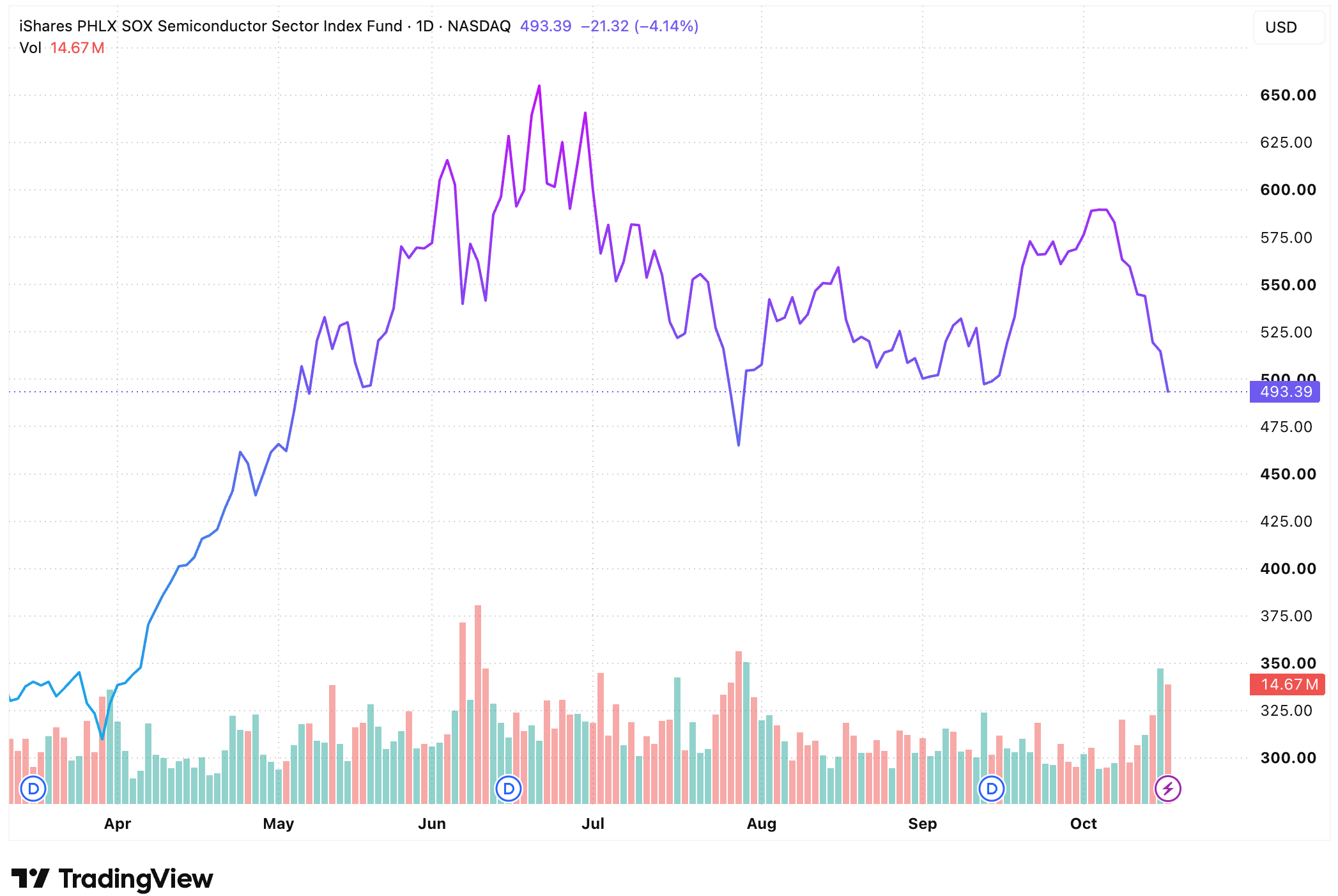
Then came the debt question. CoreWeave, carrying roughly $50 billion in borrowings, tumbled, spreading concern that rising rates could erode the returns on leveraged AI build-outs [3]. The iShares Semiconductor ETF (SOXX) fell for eight straight sessions through the 15th, down 12.6% from its Oct. 2 close [4]. TSMC guided fourth-quarter revenue to $52.3–54.3 billion that same day, but it was not enough to turn the tide [5]. As of Friday, CME FedWatch put the odds of an October hike at 17% and a December hike at 89% [6].
The shock in Seoul was far more severe. The KOSPI fell to 6,384.24 on the 12th (-3.65%), 6,035.35 on the 13th (-5.46%) and 6,008.81 on the 14th (-0.44%). On the 15th, an intraday drop of more than 9% triggered a circuit breaker — a market-wide trading halt — and the index closed at 5,554.22 (-7.57%). Foreign investors dumped about KRW 3.62 trillion of KOSPI shares that day, as Samsung Electronics sank 9.48% to KRW 210,000 and SK hynix slid 11.06% to KRW 1,262,000 [7]. Foreigners turned net buyers of KRW 341 billion on Friday, lifting the KOSPI 2.05% to 5,668.05 and snapping a seven-session losing streak [8]. Still, the index finished the week down 14.46%, while the tech-heavy KOSDAQ lost 10.93%, from 892.27 to 794.78.
Technical Analysis
The S&P 500 closed at its low of the week, ending a 55-session streak without a daily decline of 1% or more [4]. On S&P 500 futures, first support sits near 7,668, where the Sept. 18 and Oct. 1 lows converge, followed by the 20-week exponential moving average around 7,609; resistance on any recovery lies at 7,850–7,900 [9].
The VIX jumped 34.7% to 19.99 from 14.84, and the Fear & Greed Index held in "Fear" territory at 30 [4].
Bonds moved the other way. The 10-year Treasury yield spiked to 5.33% intraday after the CPI print [6], then fell as the tech selloff drove a flight to safety, closing Friday at 5.09% — 15 basis points below the prior week's 5.24% (U.S. Treasury closing yields).
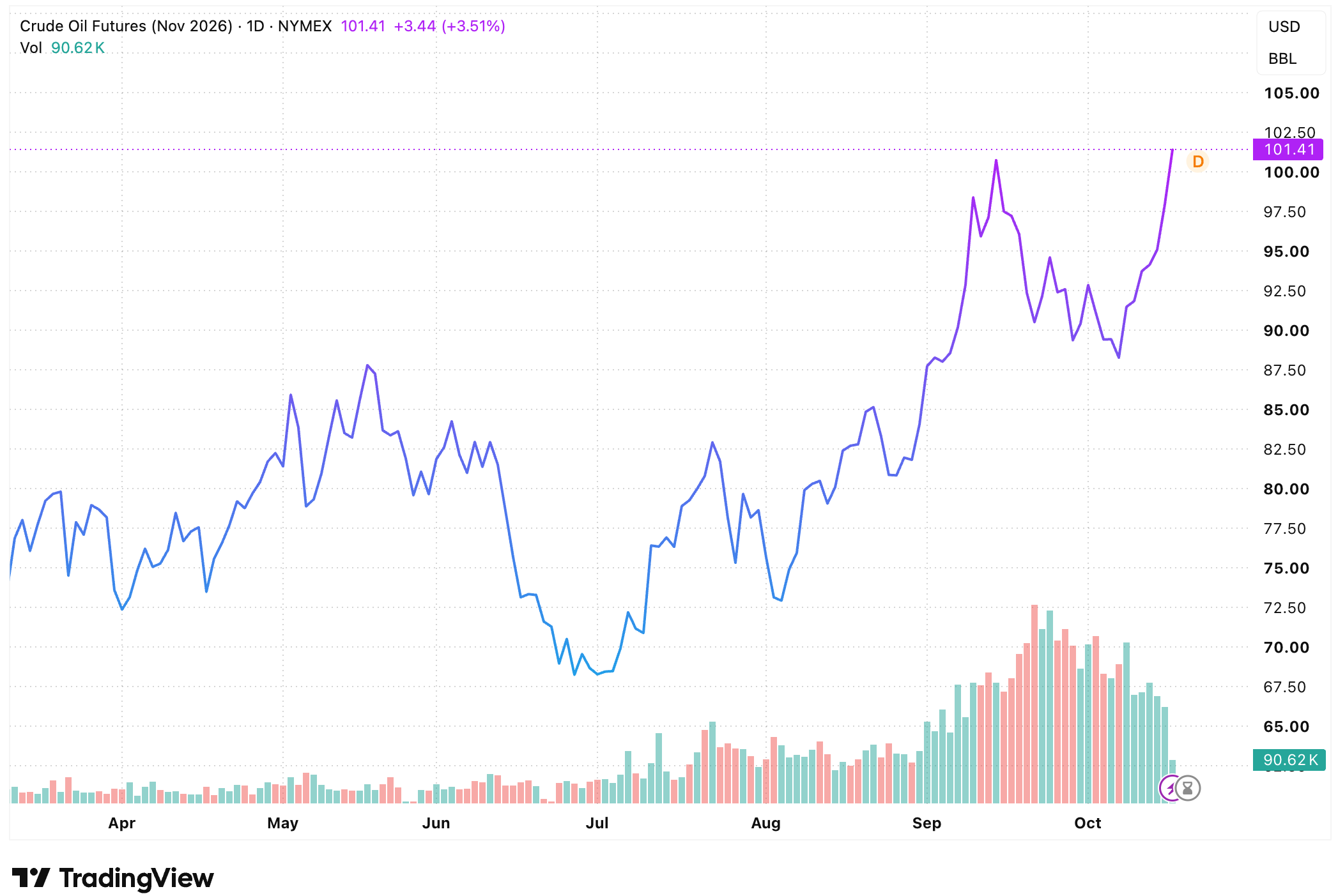
Oil added to the inflation worry: reports of strikes on Saudi Arabia's East-West pipeline and an outage at a Russian refinery pushed November WTI to a $101.41 settlement [10], up roughly 10.4% on the week.
This week, Big Tech earnings and the Bank of Korea will determine whether an oversold bounce can stick.
Netflix reports on Tuesday (Oct. 20), followed by Tesla, Meta, IBM and Texas Instruments on Wednesday (Oct. 21). It is Big Tech's first chance to answer last week's question: is AI spending translating into revenue and cash flow? The Bank of Korea announces its rate decision on Thursday (Oct. 22), and Friday (Oct. 23) brings flash October PMIs and the final University of Michigan sentiment reading. With the FOMC meeting on Oct. 27–28, this week's data will help reprice December hike expectations.
▲ Bull Case
If Meta and Tesla show tangible returns on their AI investment and oil cools, the 10-year could stabilize around 5.1%, opening the door to a technical rebound in chips. Should foreign buying that began on Friday persist, the KOSPI — the hardest hit — has the most room to retrace.
▼ Bear Case
If Big Tech's capex keeps outrunning cash flow, or oil holds above $100 and stokes inflation expectations, the 7,668 support on S&P futures could be retested. In that scenario, renewed foreign selling would likely reignite volatility in Korean equities.
Positioning Takeaways
Last week's rout was less an earnings shock than a discount-rate and funding-cost shock. Reviewing leverage first, and spreading risk across assets with different sensitivities to rates and oil, looks like the prudent approach.
Key Charts
Fig 1: Semiconductor ETF (SOXX) — Eight Straight Losses, Down 12.6% Since Oct. 2
source: tradingview.com
Fig 2: WTI Crude — From $91.85 to $101.41, Oil Reignites the Inflation Channel
source: tradingview.com
Investment Theme Spotlight
$100 Oil: Energy as an Inflation Hedge
When inflation is pushing rates higher, energy — the very source of that inflation — can act as a portfolio shock absorber.
In the September CPI, the energy index rose 5.2% month over month and gasoline 9.1% [1]. On Oct. 16, December Brent settled at $109.86, its highest level since May [10], while the S&P 500 energy sector gained 2.52% — the mirror image of a tech sector that lost more than 3%. Where tech was hit by the "higher rates, higher discount rate" channel, energy producers sit on the side of that same channel where earnings estimates rise.
Related ETFs:
- XLE (Energy Select Sector SPDR Fund): Tracks the S&P 500 energy sector with heavy weights in large integrated oil majors. Their refining and marketing operations make it relatively less sensitive to swings in crude.
- XOP (SPDR S&P Oil & Gas Exploration & Production ETF): Holds exploration and production companies on a near-equal-weight basis, giving it greater sensitivity to oil prices than XLE.
Risk Factors: Geopolitical premiums built on unconfirmed supply-disruption reports often bleed out within a session or two [10]. The IEA's plan to release another 100 million barrels of emergency stocks and Washington's consideration of easing sanctions on "shadow fleet" tankers are downside supply risks [3], and a weakening demand outlook could drag energy stocks lower as well.
Macro Dashboard
Key Changes Last Week
| Indicator | Level | Change | Takeaway |
|---|---|---|---|
| S&P 500 | 7,659.44 | 7,811.54 → 7,659.44 (-1.95%) | Closed at weekly low; biggest weekly drop since June |
| Nasdaq Composite | 26,140.03 | 27,366.17 → 26,140.03 (-4.48%) | Four-week win streak ends; AI and chips sold hard |
| Dow Jones | 52,002.41 | 51,654.95 → 52,002.41 (+0.67%) | Second weekly gain; lower tech weighting helped |
| KOSPI | 5,668.05 | 6,625.93 → 5,668.05 (-14.46%) | Circuit breaker on 15th; 7-day losing streak ended on 16th |
| KOSDAQ | 794.78 | 892.27 → 794.78 (-10.93%) | Both Korean markets halted on 15th |
| US 10-Year Treasury | 5.09% | 5.24% → 5.09% (-15bp) | 5.33% intraday after CPI, then flight to safety |
| VIX | 19.99 | 14.84 → 19.99 | Volatility spikes to just under 20 |
| Fear & Greed | 30 (Fear) [4] | 53 (Neutral) a month ago → 30 | Sentiment remains depressed |
| WTI Crude (Nov.) | $101.41 | $91.85 → $101.41 (~+10.4%) | Middle East supply risk back in focus |
| USD/KRW | 1,331.4 | 1,344.6 on 15th → 1,331.4 on 16th (daytime session close) | Won recovers alongside equity rebound |
Key Events This Week
✔︎ Netflix Q3 earnings (Oct. 20): First major Big Tech report of the season; subscriber growth vs. content spending
✔︎ Tesla, Meta, IBM Q3 earnings (Oct. 21): First real test of whether AI capex is converting into revenue and cash flow
✔︎ Bank of Korea rate decision (Oct. 22): Policy stance amid an equity crash and won volatility
✔︎ Flash October PMIs, final UMich sentiment (Oct. 23): Gauging how the oil spike is feeding into growth and inflation expectations
Sources
Market data: exchange closing prices, U.S. Treasury published yields, Seoul FX market daytime session close
[1] investingLive, US September CPI 3.7% vs 3.6% expected — https://investinglive.com/news/us-september-cpi-vs-3-6-expected-0/
[2] Zacks, PPI, Retail Sales Jump, Claims Stay Resilient — https://www.zacks.com/stock/news/3008652/ppi-retail-sales-jump-claims-stay-resilient
[3] TheStreet, Stock Market Today (Oct. 16, 2026): AI 'bubble' worries mount as Nasdaq, Russell 2000 sink on tech declines — https://www.thestreet.com/stock-market-today/stock-market-today-dow-jones-sp-500-nasdaq-updates-oct-16-2026 (citing Reuters)
[4] Investrade (Hammerstone Markets), Market Review: October 16, 2026 — https://investrade.com/market-review-october-16-2026/
[5] TSMC filing (Form 6-K), Q3 2026 results and Q4 guidance — https://www.sec.gov/Archives/edgar/data/0001046179/000104617926000726/a3q26e_withguidancexfinal.htm
[6] Investopedia via Yahoo Finance, Markets News, Oct. 16, 2026: Nasdaq, S&P 500 End Lower, Post Weekly Losses — https://finance.yahoo.com/markets/stocks/articles/markets-news-oct-16-2026-103800633.html
[7] Businesskorea, [Market Close] KOSPI plunges 7.57% to 5,500 level on foreign selling — https://www.businesskorea.co.kr/news/articleView.html?idxno=278913 (foreign net selling ranges from KRW 3.621–3.635 trillion depending on tally time)
[8] Businesskorea, [Market Close] KOSPI snaps seven-session losing streak, recovers 5,600 — https://www.businesskorea.co.kr/news/articleView.html?idxno=279010
[9] investingLive, S&P 500 analysis and forecast after the "AI bubble" panic — https://investinglive.com/technical-analysis/s-p-500-analysis-and-forecast-after-the-ai-bubble-panic/ (S&P 500 E-mini futures)
[10] Newsquawk, CRUDE WRAP: WTI (X6) settles USD 3.44 higher at USD 101.41/bbl; Brent (Z6) settles USD 3.94 higher at USD 109.86/bbl — https://www.newsquawk.com/headlines/crude-wrap-wti-x6-settles-usd-344-higher-at-usd-10141bbl-brent-z6-settles-usd-394-higher-at-usd-10986bbl


