


"Alphabet's Worst Day in Two Decades, Intel Down 29% — Markets Now Ask Not How Much Big Tech Spends on AI, but How Much It Earns"
Deteriorating cash flow at Alphabet and Amazon, compounded by Intel's guidance shock, pushed the Nasdaq down 2.00% for the week, its third straight weekly decline alongside the S&P 500. This week, Tuesday's U.S. midterm elections and Friday's October jobs report add a rates variable to a market that is now sorting AI winners from AI cash-burners.
Last week, cash flow split Big Tech's report cards.
Index Performance
The S&P 500 slipped from 7,623.68 to 7,580.07 (-0.57%) and the Nasdaq Composite fell from 25,955.34 to 25,437.00 (-2.00%), both down for a third straight week. The Dow lost 0.85% to 51,770.31 from 52,215.16, snapping a three-week winning streak (weekly changes calculated from prior Friday closes). The Nasdaq shed 5.3% in October, its worst month since March 2025.
What separated winners from losers was cash, not headline earnings. Alphabet reported third-quarter free cash flow of negative $9.1 billion[1], and its shares sank 12.64% on Thursday — the worst day in more than 20 years[1][2]. Microsoft, whose operating cash flow covered its capital spending, held up with a 0.16% dip the same day[1]. Amazon grew AWS revenue 39%, but trailing-12-month free cash flow hit a record outflow of $42.4 billion, and the company stuck to roughly $220 billion of capex this year[3][4]. On Friday, Intel plunged about 29% on weak fourth-quarter guidance — its steepest one-day drop on record[4].
The macro backdrop tilted hawkish. The FOMC held the fed funds target at 3.75%–4.00% on Wednesday, but in a 10–2 vote, with both dissenters favoring a 25 bp hike[5]. September PCE inflation came in at 3.6% year over year and core PCE at 3.1%, both in line, while third-quarter GDP grew at a 3.4% annualized pace, above the 3.2% consensus[6]. CME FedWatch put the odds of a December hike at 79.6% on Thursday morning[6]. On Friday, St. Louis Fed President Alberto Musalem and Richmond Fed President Tom Barkin both signaled further hikes may be needed[2].
In Seoul, earnings lifted the market — then dragged it back down. After SK hynix posted third-quarter operating profit of 83.33 trillion won and announced an additional 60 trillion won in shareholder returns[7], the KOSPI soared 6.63% on Wednesday to 6,012.44, reclaiming 6,000 for the first time in 10 sessions. On Thursday, Samsung Electronics fell 4.13% despite record quarterly operating profit of 107.44 trillion won, as investors were disappointed by the absence of a concrete shareholder-return plan[8]. On Friday, foreign investors sold a net 1.62 trillion won of KOSPI shares, and the index fell 3.48% to 5,730.74[9]. Still, the KOSPI ended the week up 3.25%, while the small-cap KOSDAQ fell 3.63% to 724.38 from 751.69.
Technical Analysis
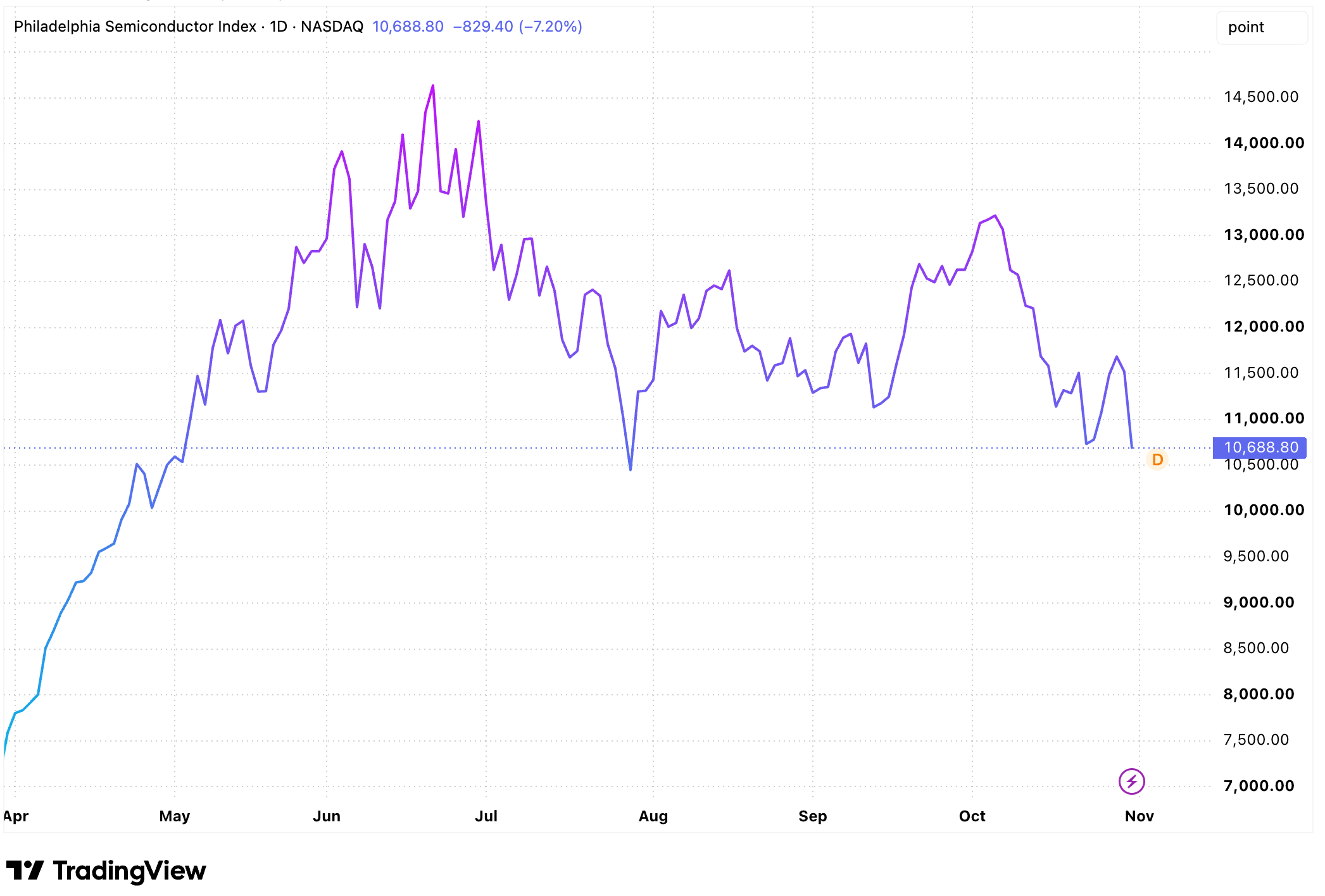
The Philadelphia Semiconductor Index (SOX) tumbled more than 7% on Friday, breaking below its 200-day moving average (around 10,785), and lost more than 15% in October[4]. Yet the S&P 500 fell just 0.6% for the week — a sign the selloff was a narrow correction concentrated in technology and communication services. Truist CIO Keith Lerner put further downside for tech at roughly 2% to 8% and said the longer-term uptrend remains intact[2]. The VIX spiked as high as 23.93 intraday on Friday before closing at 19.42, little changed from 19.45 a week earlier, while the CNN Fear & Greed Index stood at 26 ("Fear")[10].
Treasuries continued to act as a haven. The 10-year yield fell 6 bp to 4.94% from 5.00%, and the 2-year eased to 4.56% from 4.69% (U.S. Treasury closing yields). Oil moved the other way: amid reports the U.S. could resume strikes on Iran after the midterms[2], December WTI settled at $104.12, its highest close since Sept. 15, capping a gain of more than 15% in October[4]. Also on Friday, a record $6.3 billion hack at Binance knocked Bitcoin back to the $77,000 area[4].
This week, the midterms and October payrolls will re-measure the slope of the tightening path.
Americans vote in the midterm elections on Tuesday, and the October jobs report closes out the week on Friday. September payrolls rose just 29,000 and the unemployment rate climbed to 4.2%; Yardeni Research expects October payrolls to rise by about 55,000[5]. Overseas, markets are heavily pricing 25 bp hikes from the Reserve Bank of Australia on Tuesday and the Bank of England on Thursday[5]. On earnings, Apple and Palantir kick off the week on Monday, followed by AMD and Qualcomm — a test of whether chip sentiment has found a floor.
▲ Bull Case
If payrolls show only a gradual slowdown that tempers December hike bets, and AMD and Qualcomm confirm solid demand, the SOX could attempt to reclaim its 200-day line. The lifting of election-related policy uncertainty could itself dampen volatility. With chip earnings momentum intact, the KOSPI would retain room for another run at 6,000.
▼ Bear Case
A stronger-than-expected jobs print could make a December hike a foregone conclusion and raise the discount-rate burden. If post-election strikes on Iran materialize and push oil another leg higher, inflation worries would reignite. In that scenario, the SOX's break below its 200-day line could harden into a trend, and foreign selling could drag the KOSPI back below 5,600.
Positioning Takeaways
The dividing line in this phase is not AI exposure but cash-flow visibility. Within Big Tech itself, share prices diverged sharply between companies whose AI investments are visibly paying back and those whose aren't. Investors may want to check capex relative to operating cash flow across their holdings and blend in sectors that are relatively resilient to high oil prices and high rates.
Key Charts
Fig 1: Philadelphia Semiconductor Index (SOX) — Down 7.2% on Intel Shock, Breaks Below 200-Day Line
source: tradingview.com
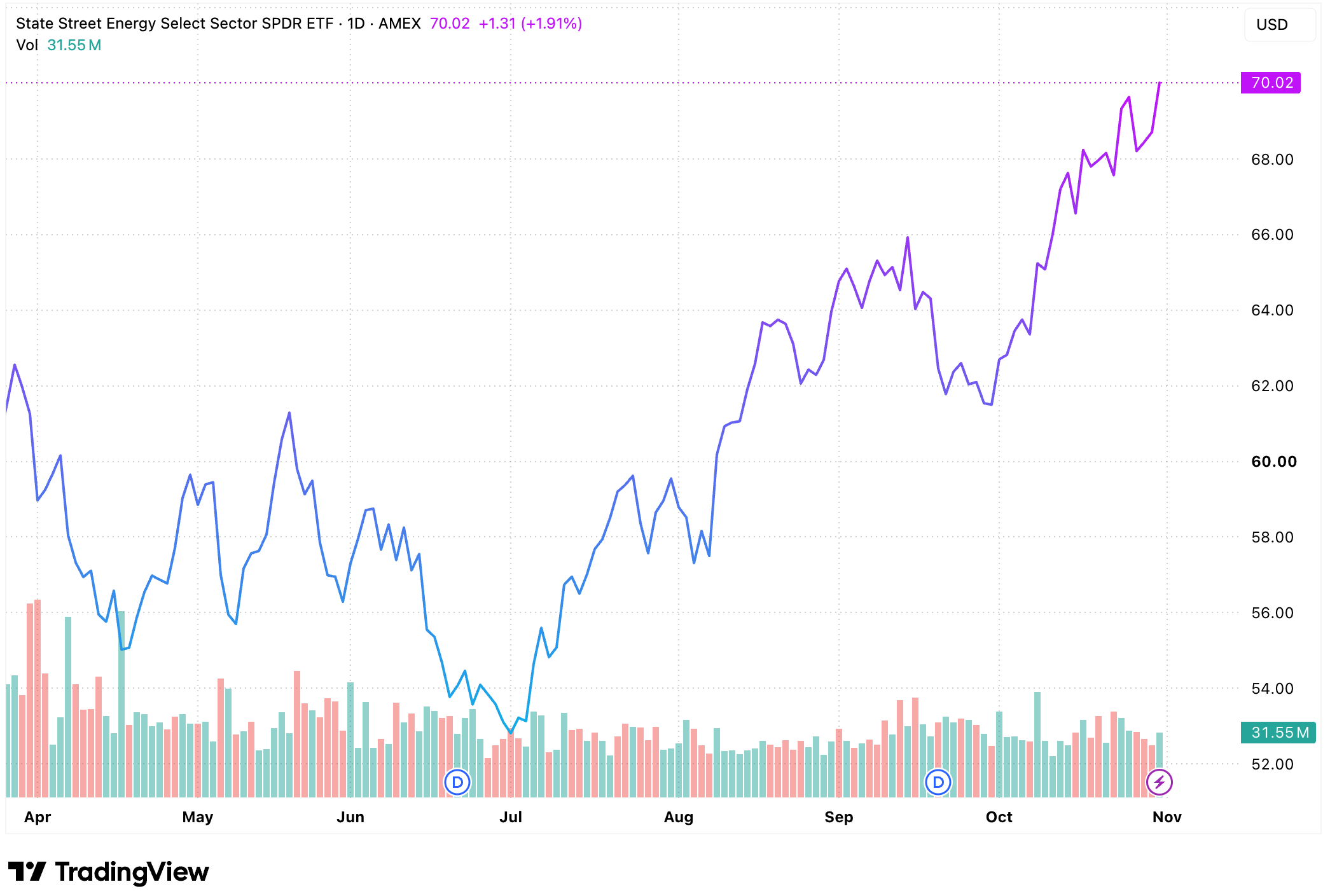
Fig 2: Energy Select Sector ETF (XLE) — Up 13% in October as WTI Tops $104
source: tradingview.com
Investment Theme Spotlight
Energy: The Cash Generator of a High-Oil-Price Regime
While AI spending is burning cash, rising oil prices are swelling energy companies' coffers.
The Energy Select Sector SPDR Fund (XLE) gained 13% in October, while WTI rose more than 15%, its fourth straight monthly gain[4]. On Friday, ExxonMobil and Chevron reported third-quarter profits above expectations as Middle East conflict sent refining margins soaring, and both stocks touched 52-week highs intraday[4]. With low correlation to tech and high dividend payouts, the sector is increasingly cited as a counterweight for portfolios concentrated in AI megacaps. Unlike Big Tech, where capex is swallowing cash, energy currently sits on the side where cash is piling up.
Related ETFs/Stocks:
- XLE (Energy Select Sector SPDR Fund): Tracks the S&P 500 energy sector with heavy weightings in ExxonMobil and Chevron, making it the most direct large-cap sector proxy for oil prices and integrated-major earnings.
- VDE (Vanguard Energy ETF): Holds a broader mix of large-, mid- and small-cap energy names, offering more diversification than XLE at a relatively low expense ratio.
Risk Factors: Oil is highly sensitive to geopolitical headlines and could retrace quickly if U.S.–Iran negotiations make progress. October's surge has also crowded positioning. And if prolonged high prices dent demand, next year's earnings estimates could be revised lower.
Macro Dashboard
Key Moves Last Week
| Indicator | Level | Change | Takeaway |
|---|---|---|---|
| S&P 500 | 7,580.07 | 7,623.68 → 7,580.07 (-0.57%) | Third straight weekly loss, but a contained one |
| Nasdaq Composite | 25,437.00 | 25,955.34 → 25,437.00 (-2.00%) | -5.3% in October, worst month since March 2025 |
| Dow Jones | 51,770.31 | 52,215.16 → 51,770.31 (-0.85%) | Three-week winning streak ends |
| KOSPI | 5,730.74 | 5,550.30 → 5,730.74 (+3.25%) | +6.63% Wed., -3.48% Fri. |
| KOSDAQ | 724.38 | 751.69 → 724.38 (-3.63%) | Small-cap tech weakness persists |
| U.S. 10-Year Treasury | 4.94% | 5.00% → 4.94% (-6 bp) | Haven demand amid tech selloff |
| VIX | 19.42 | 19.45 → 19.42 | Spiked to 23.93 intraday Fri., then calmed |
| Fear & Greed | 26 (Fear) [10] | Still in Fear zone | Sentiment subdued, short of Extreme Fear |
| WTI Crude (Dec.) | $104.12 | $103.27 → $104.12 (+0.8%) | Highest close since Sept. 15 |
| USD/KRW | 1,334.3 | 1,324.6 → 1,334.3 (Seoul day-session close) | Won weakens on foreign selling |
Events to Watch This Week
✔︎ ISM Manufacturing PMI; Apple and Palantir earnings (Nov. 2): Whether price pressures persist after September's 77.9 prices-paid reading
✔︎ U.S. midterm elections; RBA rate decision (Nov. 3): Fiscal and foreign-policy path after the vote, and the global tightening trend
✔︎ Bank of England rate decision (Nov. 5): A 25 bp hike would signal synchronized tightening among major economies
✔︎ U.S. October jobs report (Nov. 6, 8:30 a.m. ET): Pace of labor-market cooling and December FOMC hike odds
Sources
Market data: exchange closing prices, U.S. Treasury published yields, NYMEX settlements, Seoul FX market day-session close
[1] StockTitan, Stock Market Today October 29, 2026: Nasdaq Falls as Alphabet Drops; Amazon and Intel Slide After Hours — https://www.stocktitan.net/articles/stock-market-today-live-october-29-2026 (Alphabet free cash flow per company's own measure)
[2] Yahoo Finance, Stock market today: Nasdaq, Dow, S&P 500 clobbered as October closes with brutal sell-off — https://finance.yahoo.com/markets/live/stock-market-today-friday-october-30-dow-sp-500-nasdaq-amazon-intel-ai-sell-off-191429143.html (includes Truist CIO Keith Lerner comments and Bloomberg oil reporting)
[3] Amazon press release, Amazon.com Announces Third Quarter Results — https://press.aboutamazon.com/2026/10/amazon-com-announces-third-quarter-results
[4] Investrade (Hammerstone Markets), Market Review: October 30, 2026 — https://investrade.com/market-review-october-30-2026/
[5] Yardeni QuickTakes, Economic Week Ahead: November 2-6 — https://www.yardeniquicktakes.com/economic-week-ahead-november-2-6/
[6] Fox Business, Fed's preferred inflation gauge rose in September as third-quarter GDP beats expectations — https://www.foxbusiness.com/economy/september-2026-pce-inflation (consensus per LSEG)
[7] SK hynix regulatory filing (Q3 results and shareholder-return resolution), as reported by SBS Biz — https://biz.sbs.co.kr/amp/article/20000342638
[8] Samsung Electronics regulatory filing (Q3 results), as reported by Hankook Ilbo — https://www.hankookilbo.com/news/article/A2026102916580005679
[9] Businesskorea, [Market Close] KOSPI plunges 3.5% under global tech rout, barely holds 5,700 — https://www.businesskorea.co.kr/news/articleView.html?idxno=280098 (foreign net selling ranges from 1.62 to 1.84 trillion won across outlets; majority figure adopted)
[10] FinHacker, Fear and Greed Index: Historical Data & Chart (CNN Fear & Greed value for Oct. 30) — https://www.finhacker.cz/en/fear-and-greed-index-historical-data-and-chart/
※ This article was written based on the analysis of generative AI.
※ This investment market report is prepared for informational purposes only and should not be interpreted as a solicitation to buy or sell any specific investment product or as investment advice. The final investment decision and the resulting liability rest solely with the investor.


