


"Meta's First Cash Burn Delivers the AI Bill — and Money Fled Tech for Consumer Staples"
Meta reported negative free cash flow for the first time since its 2012 IPO year, sending the Nasdaq 100 down 2.9% in a single session on Thursday as money rotated into consumer staples and Treasuries. This week, Wednesday's FOMC decision, earnings from Microsoft, Alphabet and Amazon, and Thursday's PCE inflation data will put a fresh price on that bill.
Last week was dominated by a single question: who pays for the AI build-out?
Index Performance
The S&P 500 slipped 0.47% to 7,623.68 from 7,659.44, and the Nasdaq Composite fell 0.71% to 25,955.34 from 26,140.03 — a second straight weekly loss for both. The Dow rose 0.41% to 52,215.16 from 52,002.41, its third consecutive weekly gain (weekly changes calculated from prior-week closes). The trigger was Meta's report after Wednesday's close. Third-quarter revenue rose 26% to $64.6 billion and fourth-quarter guidance of $73–76 billion topped consensus, but free cash flow came in at negative $2.12 billion — the first cash burn since the company's IPO year [1]. Capital spending consumed 104% of operating cash flow. The same day, Tesla cut its full-year capex guidance by roughly 20%, prompting some to argue the AI investment boom may already have peaked [2].
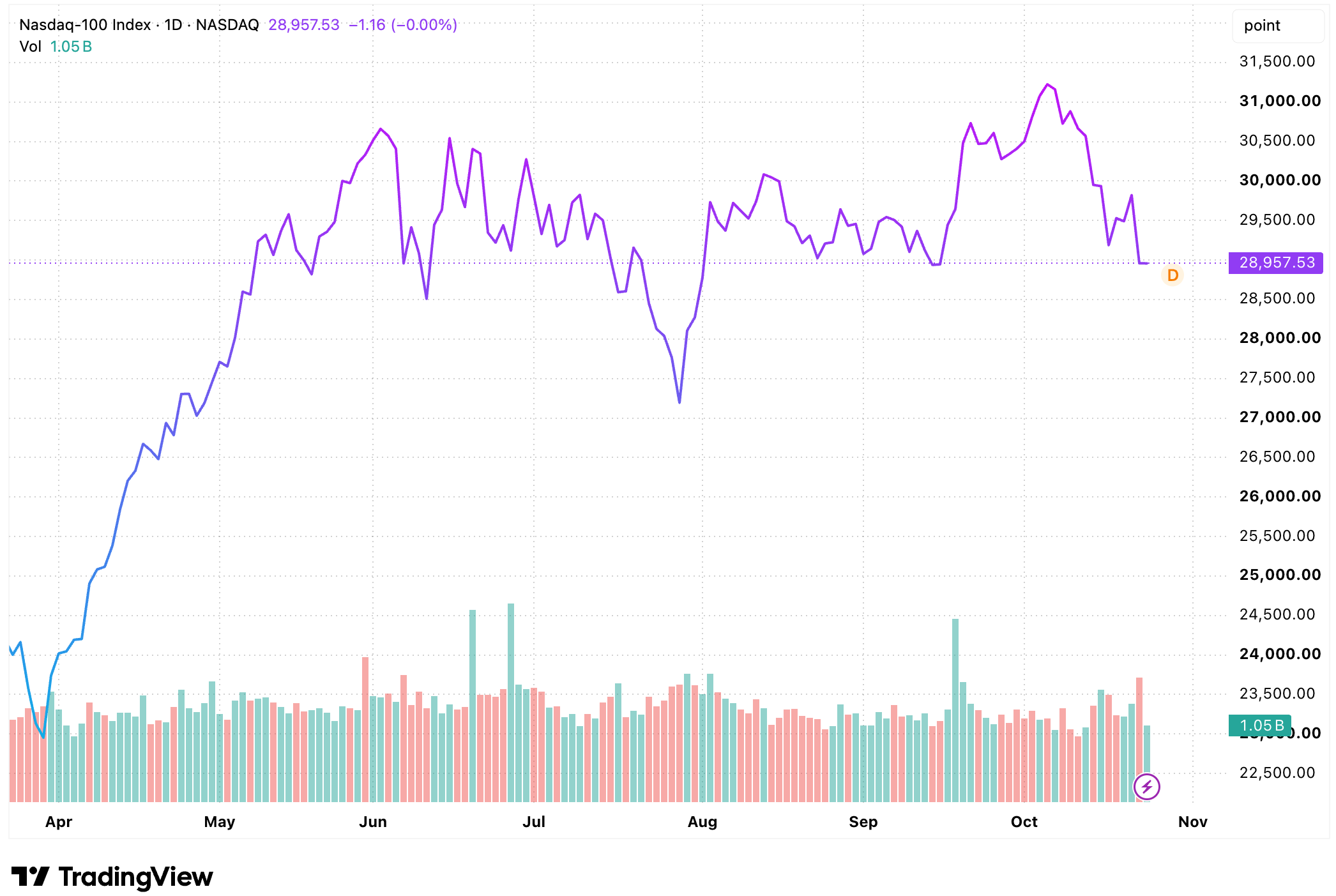
Meta sank 6.98% on Thursday. The Nasdaq Composite dropped 2.60% to 26,008.86, the Nasdaq 100 lost 2.9% in its worst session since June, and the Philadelphia Semiconductor Index tumbled 6.7% [1]. On Friday, fears of renewed U.S.-Iran fighting lifted oil, and American Express said it would cut about 5% of its workforce, dragging the Dow down 652.82 points, or 1.23% [3].
Korean equities swung day to day. The KOSPI rebounded 1.76% on Monday, then plunged 3.73% to 5,552.74 on Tuesday as foreign and institutional investors sold in tandem [4]. On Friday it fell more than 4% intraday, to around 5,300, before dip-buying by retail and institutional investors lifted it to a 0.30% gain at 5,550.30. SK hynix jumped 4.42% that day after its Solidigm unit dropped plans for a U.S. listing [5]. For the week, the KOSPI lost 2.08% and the tech-heavy KOSDAQ fell 5.42%, from 794.78 to 751.69. On Thursday, the Bank of Korea unanimously held its policy rate at 3.00% [6].
Technical Analysis
The S&P 500 and Nasdaq both hit fresh five-week lows early Friday [7]. Even so, SPY remains within 3% of its record, and the equal-weight S&P 500 is outperforming the cap-weighted index by the widest monthly margin since April 2009 [1] — a sign this is less a broad liquidation than an unwinding of megacap tech concentration. The weak link is semiconductors. The iShares Semiconductor ETF (SOXX) fell 6.62% on Thursday, testing its 200-day moving average ($473.39) for the first time in 16 months [7]. The VIX eased to 19.45 from 19.99, but the Fear & Greed Index slid to 20 ("Extreme Fear") from 32 ("Fear") a month ago [7].
Bonds did their job as a haven. The 10-year Treasury yield fell to 4.96% on Thursday, its first close below 5% since Sept. 22, before settling Friday at 5.00% — 9 basis points below the prior week's 5.09% (U.S. Treasury closing yields). Oil went the other way. With a tanker reportedly struck near the Strait of Hormuz, December WTI settled at $103.27 and Brent at $116.72 [7]; on a like-for-like December-contract basis, WTI rose about 4.3% on the week.
This week, the FOMC and hyperscaler earnings will weigh the AI bill on the same night.
The FOMC announces its decision on Wednesday, Oct. 28 (3 a.m. Thursday in Seoul), followed by Fed Chair Kevin Warsh's press conference. Microsoft and Alphabet report after Wednesday's close, with Amazon and Intel following on Thursday, when Q3 GDP and September PCE inflation are also released. CME FedWatch puts the odds of a hike this week at 9% and in December at 84% [8]. The Atlanta Fed's GDPNow tracks Q3 growth at 3.5%, while the Cleveland Fed's nowcast sees September core PCE at 3.1% year over year [8]. In Korea, SK hynix (Wednesday) and Samsung Electronics (Thursday) results will serve as a barometer for chip sentiment.
▲ Bull Case
If Microsoft and Alphabet justify their capex with cloud revenue growth and the Fed holds while staying data-dependent, the 10-year could stabilize below 5% and semiconductors could confirm support at the 200-day line. Strong HBM demand in SK hynix and Samsung results would also firm up the KOSPI's 5,500 floor.
▼ Bear Case
If hyperscalers echo Meta — rising investment, shrinking cash — or a hot PCE print cements December hike expectations, worries over discount rates and funding costs could intensify together. In that scenario, a SOXX break below its 200-day average and renewed foreign selling could drag the KOSPI back toward 5,300.
Positioning Implications
This pullback was less about the index than about where the money had piled up. Investors may want to check their exposure to the largest tech names first and blend in assets with lower correlation to the AI capex cycle.
Key Charts
Fig 1: Nasdaq 100 — down 2.9% the day after Meta, its biggest one-day drop since June
source: tradingview.com
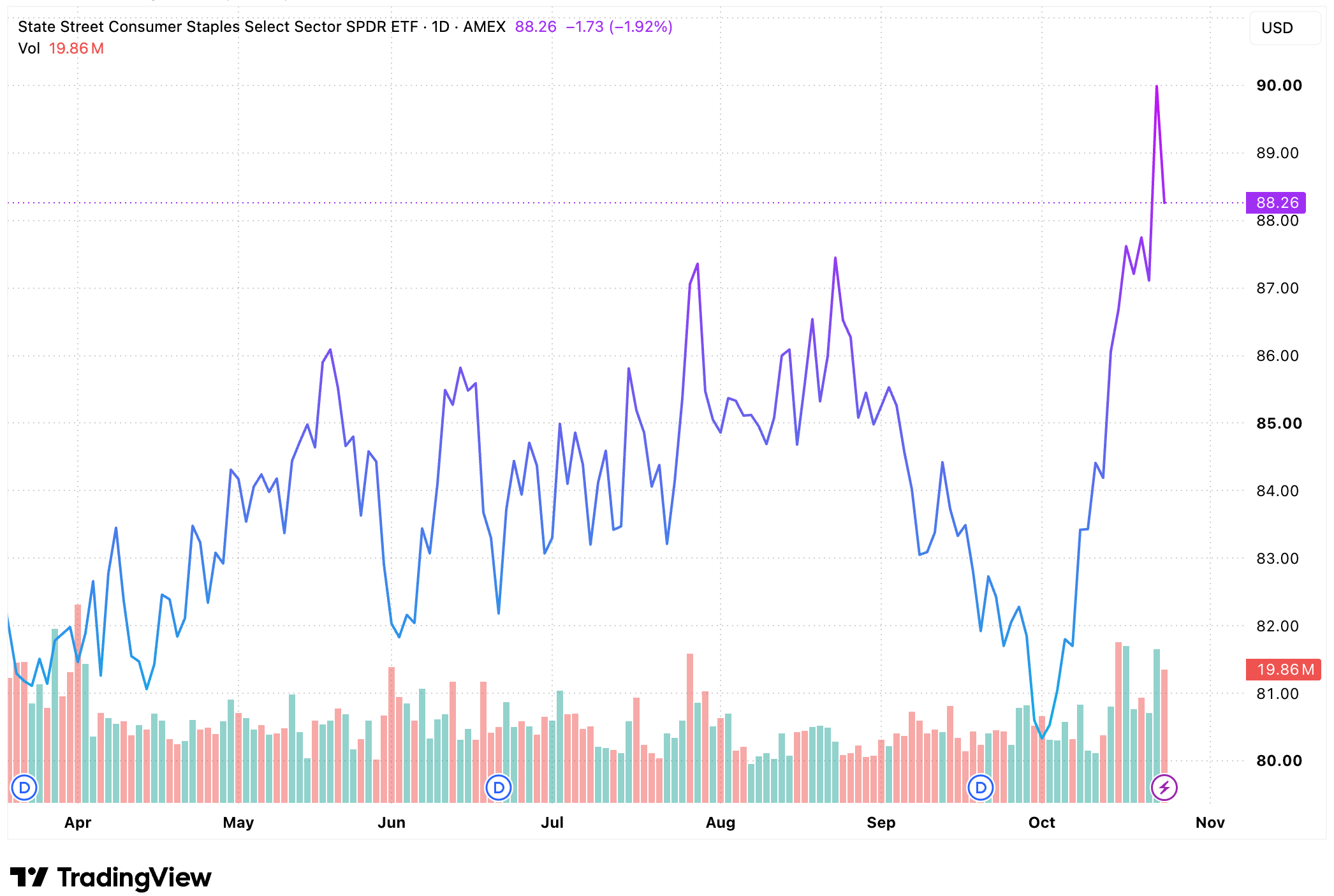
Fig 2: Consumer Staples ETF (XLP) — up 11% in October, on pace for its best month since its 1998 launch
source: tradingview.com
Investment Theme Spotlight
The Other Side of the AI Bill: Consumer Staples and Equal Weight
The louder the question "who pays for AI?" gets, the more money flows to sectors that sidestep it.
The Consumer Staples Select Sector SPDR Fund (XLP) gained 11% in October through Friday, on track for its best month since launching in December 1998, while the Technology Select Sector SPDR Fund (XLK) fell 6.9% [1]. Walmart is up about 15% this month, and Procter & Gamble jumped 5.9% on Thursday after reporting 4% organic sales growth [1]. The Russell 2000's 2.0% weekly gain fits the same pattern. In a high-rate, high-oil environment, staples offer pricing power and steady cash flow — the mirror image of capex-heavy megacap tech.
Related ETFs/Stocks:
- XLP (Consumer Staples Select Sector SPDR Fund): Tracks the S&P 500 consumer staples sector, with heavy weights in large household-goods companies. Its sensitivity to both the economic cycle and the AI investment cycle is relatively low.
- RSP (Invesco S&P 500 Equal Weight ETF): Holds S&P 500 constituents in equal weights, structurally diluting megacap tech concentration — directly aligned with this month's equal-weight outperformance.
Risk Factors: October's surge has itself stretched valuations. XLP fell 1.92% on Friday, and a rotation back into tech could come quickly if hyperscaler earnings beat expectations. With year-ahead inflation expectations in the University of Michigan survey at 4.7%, the highest since May [1], input-cost pressure on consumer-goods margins is also worth watching.
Macro Dashboard
Key Changes Last Week
| Indicator | Level | Change | Takeaway |
|---|---|---|---|
| S&P 500 | 7,623.68 | 7,659.44 → 7,623.68 (-0.47%) | Second weekly loss; five-week low on Oct. 23 |
| Nasdaq Composite | 25,955.34 | 26,140.03 → 25,955.34 (-0.71%) | -2.60% on Oct. 22 on Meta cash-flow shock |
| Dow Jones | 52,215.16 | 52,002.41 → 52,215.16 (+0.41%) | Third weekly gain despite -1.23% Friday |
| KOSPI | 5,550.30 | 5,668.05 → 5,550.30 (-2.08%) | -3.73% on Oct. 20; 4%+ intraday drop and rebound Oct. 23 |
| KOSDAQ | 751.69 | 794.78 → 751.69 (-5.42%) | Battery and biotech weakness persists |
| U.S. 10-Year Treasury | 5.00% | 5.09% → 5.00% (-9bp) | Dipped below 5% on Oct. 22 for first time in a month |
| VIX | 19.45 | 19.99 → 19.45 | Holding just below 20 |
| Fear & Greed | 20 (Extreme Fear) [7] | 32 (Fear) a month ago → 20 | Sentiment deteriorating |
| WTI Crude (Dec) | $103.27 | $99.02 → $103.27 (~+4.3%) | U.S.-Iran tension, Hormuz risk |
| USD/KRW | 1,324.6 | 1,331.4 (Oct. 16) → 1,324.6 (Oct. 23, onshore day-session close) | Won near year's high despite equity selloff |
Events to Watch This Week
✔︎ FOMC Rate Decision (Oct. 28; 3 a.m. Oct. 29 KST): December hike signals and Chair Warsh's read on inflation matter more than the hold itself
✔︎ Microsoft, Alphabet and SK hynix Earnings (Oct. 28): Can cloud revenue justify capex, and is HBM demand holding up?
✔︎ Q3 GDP, September PCE; Amazon, Intel and Samsung Earnings; ECB Meeting (Oct. 29): Growth, inflation and AI infrastructure demand all in one day
✔︎ Bank of Japan Rate Decision (Oct. 30): December hike expectations and the yen
Sources
Market data: exchange closing prices, U.S. Treasury published yields, NYMEX settlements, Seoul FX market day-session close
[1] Benzinga, Tech-to-Defensive Rotation, GM Stock Logs Worst Week Since 2023: This Week on Wall Street — https://www.benzinga.com/markets/equities/26/10/62574069/this-week-on-wall-street-staples-ai-bill-gm-fed-hyperscalers
[2] TheStreet via Yahoo Finance, Stock Market Today (Oct. 23, 2026): Dow tumbles following tech sell-off — https://finance.yahoo.com/markets/stocks/articles/stock-market-today-oct-23-134445147.html (citing Capital.com analyst Kyle Rodda)
[3] Strategitz, Global Markets Close — October 23, 2026 — https://strategitz.substack.com/p/global-markets-close-october-23-2026
[4] Businesskorea, KOSPI plunges 3.7% to 5,552 on joint foreign-institutional selling (Korean) — https://www.businesskorea.co.kr/news/articleView.html?idxno=279245 (Monday's change derived from Tuesday's close and decline)
[5] Businesskorea, KOSPI rebounds from 4% intraday slump to close at 5,550 (Korean) — https://www.businesskorea.co.kr/news/articleView.html?idxno=279567
[6] Korea Financial Times, Bank of Korea holds base rate at 3% in October (Korean) — https://www.fntimes.com/html/view.php?ud=202610221201381124179ad43907_18
[7] Investrade (Hammerstone Markets), Market Review: October 23, 2026 — https://investrade.com/market-review-october-23-2026/
[8] Yardeni QuickTakes, Economic Week Ahead: October 26-30 — https://www.yardeniquicktakes.com/economic-week-ahead-october-26-30/
※ This article was written based on the analysis of generative AI.
※ This investment market report is prepared for informational purposes only and should not be interpreted as a solicitation to buy or sell any specific investment product or as investment advice. The final investment decision and the resulting liability rest solely with the investor.


