


"Payrolls Miss at 29,000 and an October Hike Fades — Yet the 10-Year Climbs to 5.28% as Bonds Reject 'Bad News Is Good News'"
September payrolls rose by just 29,000, pushing the odds of an October Fed hike below 20%. The 10-year Treasury yield nonetheless rose 11 basis points on the week and held near its highest level since 2002. This week, a 10-year auction, the September FOMC minutes and Samsung Electronics' preliminary earnings will test one question: when does the long end catch its breath?
Last week, Fed expectations retreated — but long-term yields did not.
Major Index Performance
The S&P 500 slipped 0.27% on the week, from 7,743.41 to 7,722.72, while the Dow fell 1.26% to 51,176.96 from 51,828.62. The Nasdaq Composite bucked the trend, gaining 0.45% to a record close of 27,190.86 from 27,068.72 (Source: AP via Yahoo Finance, How major US stock indexes fared Friday 10/2/2026).
Economic data cooled across the board. Consumer confidence fell to 81.9 in September, its lowest since April 2014, and August core PCE inflation came in at 3.0% year over year, below the 3.3% consensus (Source: Elliot's Musings, Weekly Market Update — Week Ending October 2, 2026). Friday's jobs report delivered the decisive blow: nonfarm payrolls rose by 29,000, far short of the 84,000 consensus, and the unemployment rate ticked up to 4.2% (Source: TheStreet, Stock Market Today (Oct. 2, 2026); BLS, Employment Situation Summary). The probability of an October rate hike, per CME FedWatch, collapsed from roughly 70% at the start of the week to around 18% (Source: TheStreet, Oct. 2; Elliot's Musings).
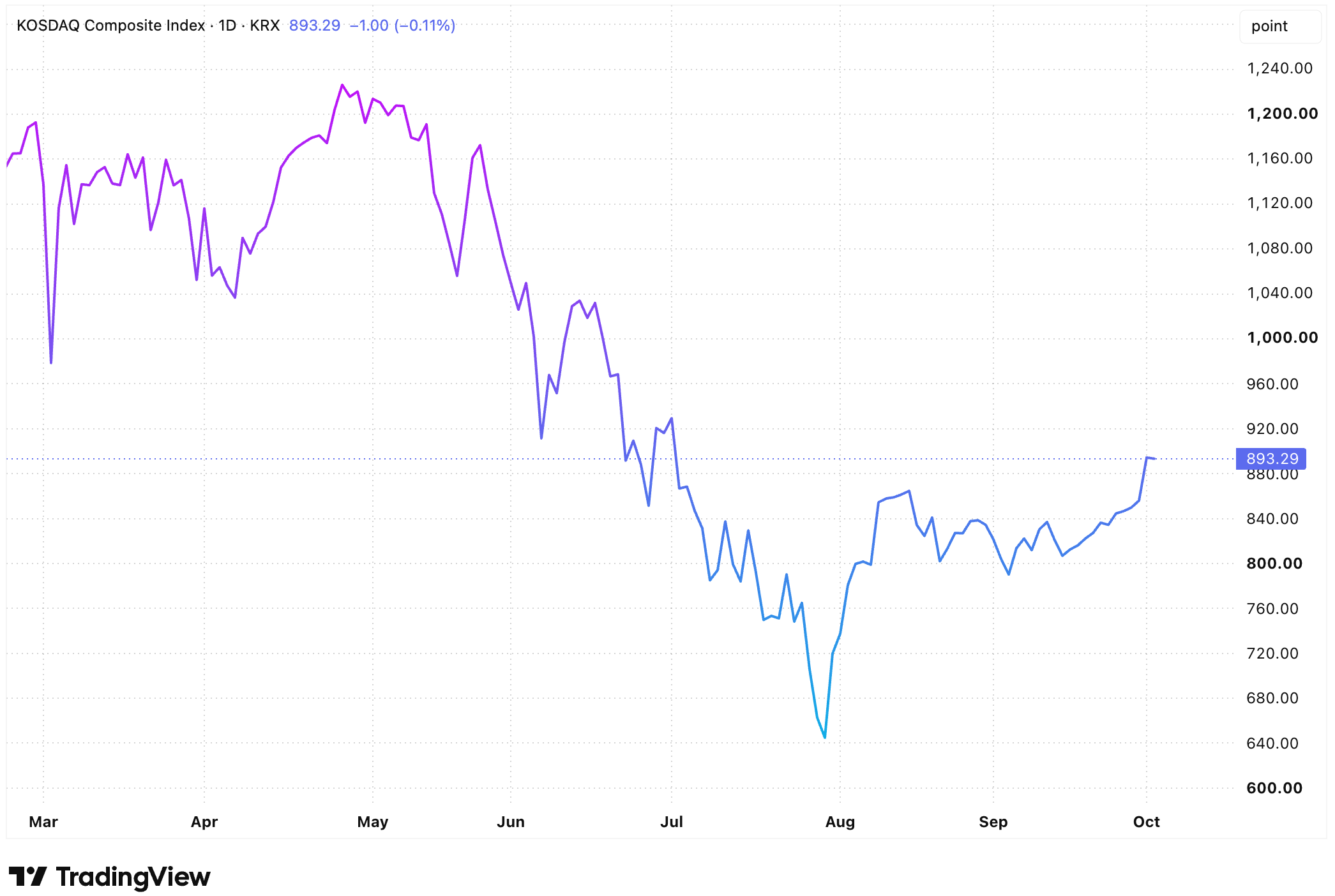
Korean equities diverged. The KOSPI closed at 7,003.74 on October 2, down 1.09% from its pre-Chuseok (Korean harvest holiday) close of 7,080.92, weighed down by the September 29 ex-dividend date (Source: Firebat, Sept. 29 market close) and more than 1 trillion won of foreign net selling ahead of another long weekend (Source: Money Today, KOSPI closes at 7003.74; Firebat, Oct. 2 market close). The tech-heavy KOSDAQ, by contrast, jumped 5.78% from 844.48 to 893.29, briefly topping 900 intraday for the first time since July (Source: Seoul Finance, KOSDAQ closes at 893.29; Seoul Shinmun, KOSDAQ reclaims 900, five straight gains).
Technical Analysis
The S&P 500 held above both its 50-day moving average (7,657.66) and 200-day moving average (7,225.82), keeping its trend intact. Underneath, however, only 24.8% of constituents trade above their own 50-day line — a narrow market in which the index holds up while most stocks lag (Source: Advisor Perspectives, S&P 500 Snapshot: Stocks Rally to Close Out Flat Week). First support sits near 7,650, where the 50-day runs, with resistance at 7,750–7,770, the zone of the past two weeks' highs.
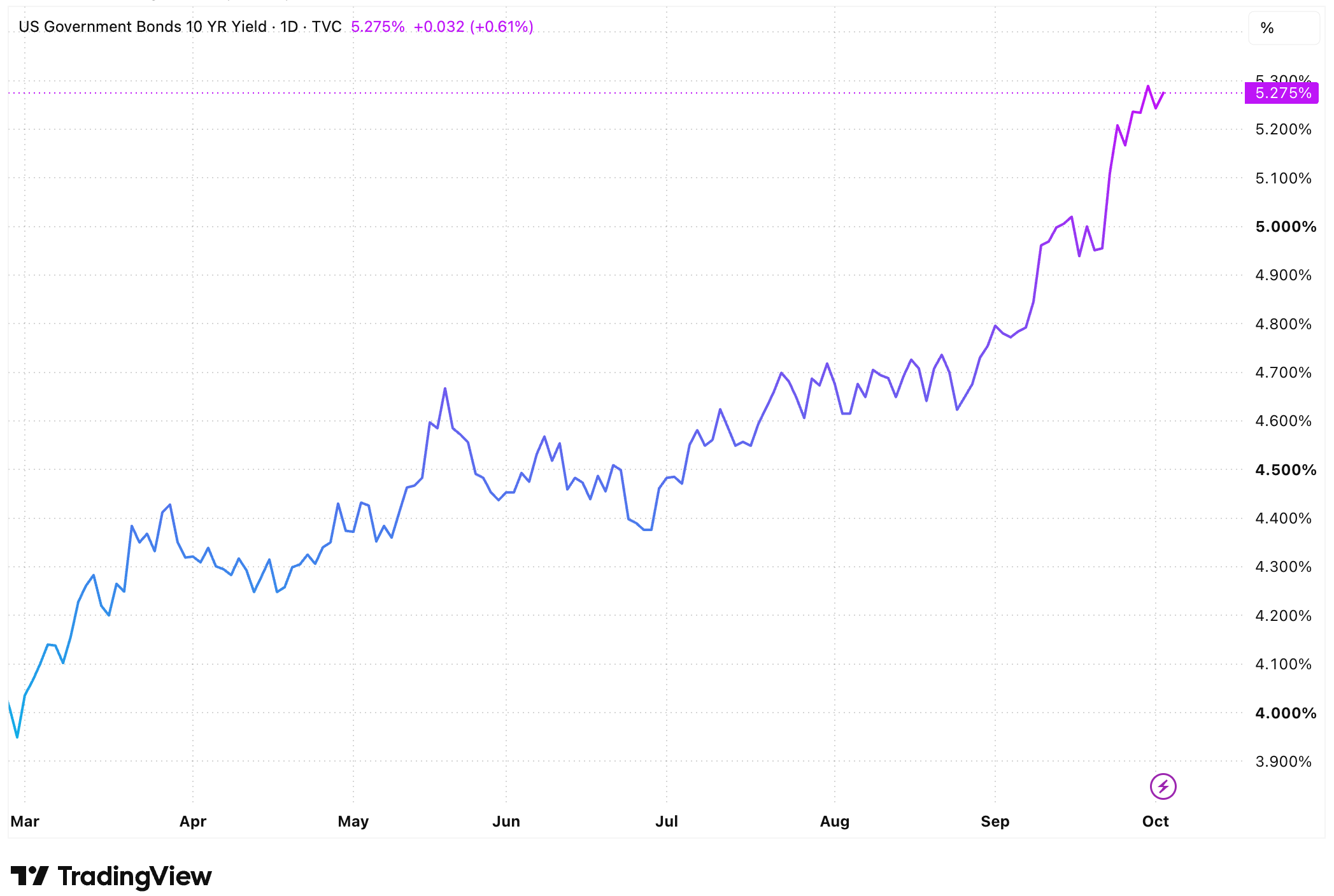
The real signal came from bonds. The 10-year yield rose from 5.17% on September 25 to 5.29% on September 30 (Source: Federal Reserve, H.15 Selected Interest Rates), then touched 5.34% intraday on Thursday, the highest since 2002 (Source: KB Kookmin Bank, Oct. 2 FX outlook). On Friday it dipped briefly after the jobs data before finishing higher at 5.281% (Source: CNBC, 10-year Treasury yield ticks higher despite weaker-than-expected jobs report).
The VIX edged up only modestly, from 14.87 to 15.31 (Source: StreetStats, VIX and MOVE), while the MOVE index of bond volatility surged to 107.3, its 98th historical percentile (Source: Elliot's Musings, same article).
The Fear & Greed Index stayed in "fear" territory at 31 (Source: Fear and Greed Graph, Fear and Greed Index Today).
In oil, a G7 agreement to release 100 million barrels from emergency reserves sent WTI to a $91.11 settle, down about 1.4% from $92.41 a week earlier (Source: EnergyNow, Oil Ends Volatile Week Mixed).
This week, the 10-year auction and FOMC minutes set the next leg for long-term rates.
The U.S. calendar is light, but the events that matter are squarely about rates.
The ISM services PMI kicks off the week on October 5 (August: 55.4), followed on October 7 by a 10-year note auction at 1 p.m. ET and the September FOMC minutes at 2 p.m. (Source: SBS Biz, Next week's economic calendar; Elliot's Musings).
The Fed unanimously raised rates by 25 basis points in September, resuming tightening for the first time in three years and two months (Source: Seoul Economic Daily, Samsung Q3 results, September FOMC minutes).
Korean markets reopen on October 6 for just three sessions before closing again on October 9 for Hangul Day. Samsung Electronics' preliminary Q3 results on October 8 are the key domestic catalyst, with the Street watching whether revenue tops 200 trillion won and operating profit clears 110 trillion won (Source: Seoul Economic Daily, same article).
▲ Upside Scenario
Solid demand at the 10-year auction and a cooler ISM services prices component could pull the 10-year back toward 5.1–5.2%, broadening the rally into rate-sensitive sectors that have been left behind. A Samsung beat would also give Korean large caps room to absorb the external shocks that piled up over the holiday.
▼ Downside Scenario
A weak auction (a "tail") combined with minutes showing broad support for further hikes could push the 10-year back above 5.3%. In that case, the pattern of stocks and bonds falling together would likely return, with already-weakened small and mid caps the first to wobble.
Positioning Implications
The story this week is the long end itself, more than the Fed's path. It is reasonable to review exposure to borrowing-dependent sectors rather than headline index weight, and to stop assuming long-duration bonds will hedge equities.
Key Charts
Fig 1: U.S. 10-Year Treasury Yield — 5.28% Despite a Jobs Miss, Near the Highest Since 2002
source: tradingview.com
Fig 2: KOSDAQ — Five Straight Gains and a First Intraday Touch of 900 Since July
source: tradingview.com
Investment Theme Spotlight
When Bonds Stop Hedging — Diversifying in an Era of Positive Stock-Bond Correlation
When long-term yields rise even as Fed expectations fade, the classic "stocks plus long bonds" mix stops doing its job.
Last week was a lesson in the power of term premium — the extra yield investors demand to hold long-dated bonds. The 63-day correlation between SPY and TLT stands at +0.49, in its 92nd historical percentile, and has been positive for 12 straight weeks (Source: Elliot's Musings, same article). If long bonds fall alongside stocks, they amplify losses rather than cushion them. Short-term Treasury yields, meanwhile, have actually eased as hike expectations faded: the 3-month T-bill yield stood at 4.00% on October 1 (Source: Fed H.15), offering roughly 4% with minimal duration risk. The quant takeaway is to treat cross-asset correlation as a moving variable, not a constant.
Related ETFs/Stocks:
- SGOV (iShares 0-3 Month Treasury Bond ETF): Holds U.S. Treasuries maturing within three months, carrying very little price risk from rate moves while tracking T-bill-level yields.
- FLOT (iShares Floating Rate Bond ETF): Invests in investment-grade floating-rate notes whose coupons reset as rates rise, often cited as a way to reduce duration exposure when long-term yields climb.
Risk Factors: If long-term yields drop sharply (on a strong auction or softer inflation), long bonds could rally hard and leave short-duration portfolios behind. And if the Fed pivots to cutting, short-term yields themselves would fall quickly.
Macro Dashboard
Key Changes Last Week
| Indicator | Level | Change | Interpretation |
|---|---|---|---|
| S&P 500 | 7,722.72 | 7,743.41 → 7,722.72 (-0.27%) | Only 24.8% of members above 50-day; narrow market |
| Nasdaq Composite | 27,190.86 | 27,068.72 → 27,190.86 (+0.45%) | Record close, led by AI hardware |
| Dow Jones | 51,176.96 | 51,828.62 → 51,176.96 (-1.26%) | Rate-sensitive and defensive names lagged |
| KOSPI | 7,003.74 | 7,080.92 → 7,003.74 (-1.09%) | Ex-dividend, pre-holiday foreign selling |
| KOSDAQ | 893.29 | 844.48 → 893.29 (+5.78%) | Five straight gains, touched 900 intraday |
| U.S. 10-Year Treasury | 5.28% | 5.17% → 5.28% (+11bp) | 5.34% intraday, highest since 2002 |
| U.S. September Payrolls | +29,000 | Missed 84,000 consensus | Jobless rate 4.2%; October hike odds ~18% |
| VIX | 15.31 | 14.87 → 15.31 | Equity volatility still subdued |
| Fear & Greed | 31 (Fear) | Remains in fear zone | Sentiment slow to recover |
| WTI Crude | $91.11 | $92.41 → $91.11 (about -1.4%) | G7 releases 100M barrels of reserves |
| USD/KRW | 1,350.60 | -7.8 won day over day (reference rate) | Widening trade surplus supports the won |
(USD/KRW source: Steel & Metal News, Oct. 2 USD/KRW at 1,350.60, Hana Bank reference rate)
Key Events This Week
✔︎ U.S. ISM Services PMI (Oct. 5): The prices component matters more than the headline — watch whether the manufacturing prices surge (77.9; Source: Elliot's Musings) is spilling into services
✔︎ U.S. 10-Year Auction and September FOMC Minutes (Oct. 7): Auction demand and the breadth of support for further hikes will steer long-term yields
✔︎ Samsung Electronics Preliminary Q3 Results (Oct. 8): Whether revenue tops 200 trillion won and operating profit 110 trillion won; the compass for a three-session Korean week
✔︎ Korean Market Holidays (Oct. 5 and Oct. 9): Substitute holiday for National Foundation Day and Hangul Day leave just three Korean trading sessions, Oct. 6–8
※ This article was written based on the analysis of generative AI.
※ This investment market report is prepared for informational purposes only and should not be interpreted as a solicitation to buy or sell any specific investment product or as investment advice. The final investment decision and the resulting liability rest solely with the investor.


