


WEEKLY GLOBAL MARKET REPORT
"US and Japan Hike Rates in Lockstep, Yet KOSPI Held Its Ground — 10-Year Yield at 2007 Highs, Korea Braces for a Three-Day Week Before Chuseok"
Last week the Federal Reserve and the Bank of Japan raised rates within a day of each other — an unusually synchronized round of tightening — yet the KOSPI still clawed back nearly all of a rollercoaster plunge-and-rebound (-3.26% then +2.66%). This week, Korean markets are open for just three trading days ahead of the Chuseok holiday, with a US-China summit and flash PMI data set to decide the direction of that short stretch.
Last week was tightening synchronization gone strange: the US and Japan both raised rates, yet KOSPI erased almost all of its losses.
Index Performance
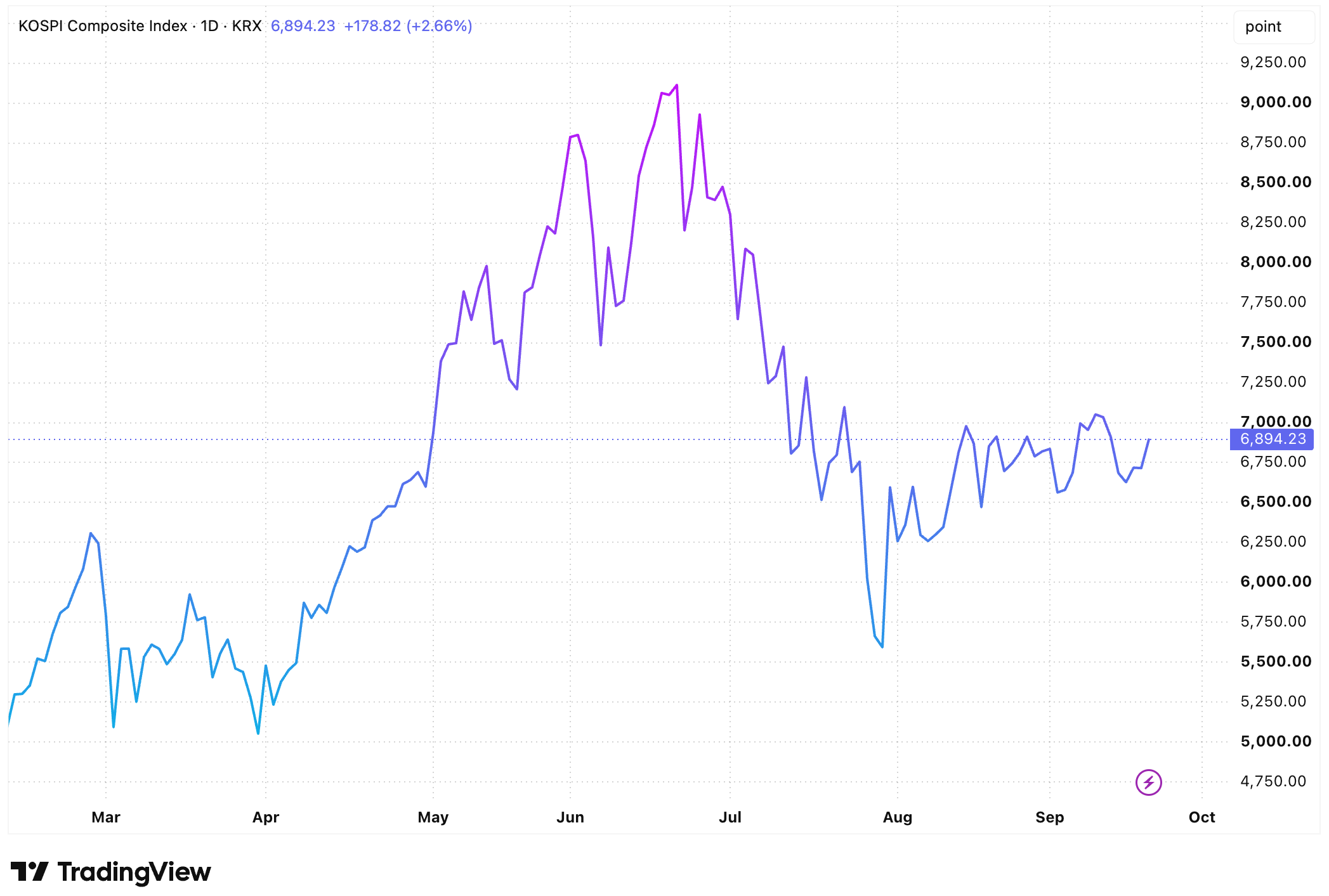
On Monday, September 14, the fallout from Friday's hotter-than-expected US CPI and PPI prints hit in full force, sending the KOSPI down 225.54 points (3.26%) to open the week at 6,684.37 (Source: Asia Economy Daily, "KOSPI closes down 225.54 points at 6,684.37"). The KOSDAQ fell in tandem, dropping 1.69% to 806.79. Tuesday brought a further 57.11-point (0.85%) slide to 6,627.26 amid a large-cap flow tug-of-war, confirming the sell-off wasn't a one-day event (Source: WikiTree, "KOSPI closes at 6,627.26 — who won the large-cap flow battle?").
The real turning point came Wednesday: even as the Fed delivered a 25-basis-point hike, lifting its target range from 3.50–3.75% to 3.75–4.00%, relief that the move had been "priced in" sent Samsung Electronics and SK Hynix up 2.01% and 4.08% respectively, driving the KOSPI up 90.71 points (1.37%) to 6,717.97 (Source: Money Today, "Chips lead the rebound as caution lingers ahead of the FOMC"; CNBC, "Fed rate decision September 2026"). It was the Fed's first hike since July 2023 — three years and two months — approved unanimously 12-0, with Chair Kevin Warsh pledging a "timelier return" to the 2% inflation target (Source: Yahoo Finance, "Fed meeting live updates"). Thursday saw defense and aerospace names explode independently of the broader tape, even as the index itself took a breather, slipping 2.56 points (0.04%) to 6,715.41 (Source: Nate News, "KOSPI closes down 0.04% at 6,715.41"). Friday brought the payoff: foreign investors turned net buyers for the first time in eight sessions, institutions piled in alongside them, and large-cap chip strength drove the index up 178.82 points (2.66%) to close the week at 6,894.23 (Source: Seoul Economic Daily, "KOSPI Closes Up 2.66% at 6,894.23").
On net, the KOSPI finished the week down just 0.23% (6,909.91 → 6,894.23), effectively unwinding Monday's 3.26% plunge, while the KOSDAQ actually outperformed, up 0.79% to 827.12 (Source: Asia Economy Daily, "Market ING: KOSPI attempts a rebound as caution builds ahead of the holiday"). US markets told a more divergent story: the S&P 500 slipped 0.1% for the week to 7,650.50 and the Nasdaq gained 0.7% to 26,522.55, while the Dow dropped 1.7% to 51,682.64 — its worst weekly showing since March (Source: TheStreet, "Stock Market Today (Sept. 18, 2026)"; CNBC, "Dow falls Friday and posts worst week since March"). That same Wednesday, the Bank of Japan also raised its policy rate by 25 basis points, from 1.00% to 1.25% — the highest level in 31 years, since 1995, and its first hike since June (Source: Asia Economy Daily, "Bank of Japan raises policy rate to 1.25%, reaffirms tightening bias").
Technical Analysis
The KOSPI's zigzag path — 6,910 → 6,684 → 6,627 → 6,718 → 6,715 → 6,894 — re-established 6,600 as near-term support and 6,900 as resistance.
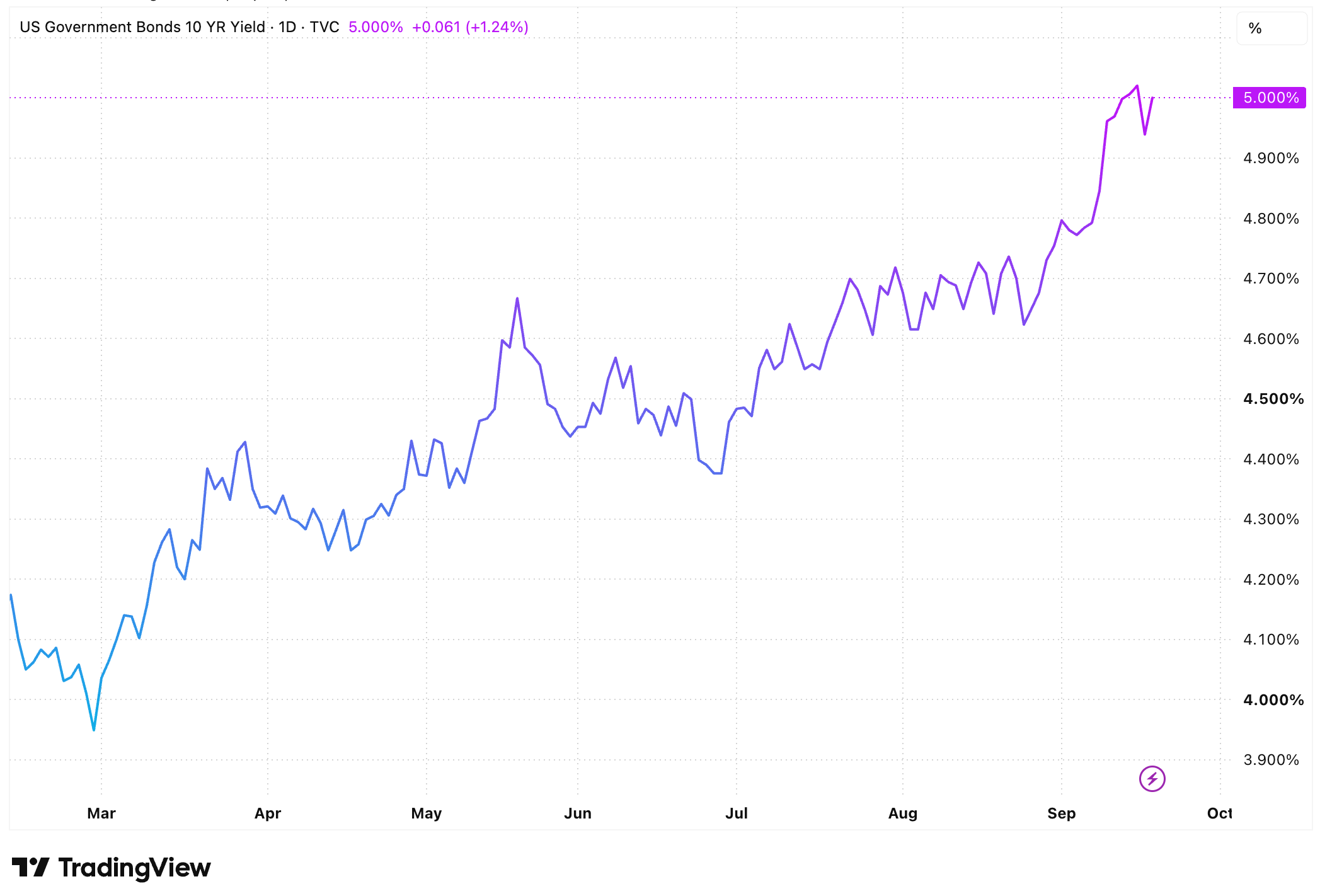
The US 10-year Treasury yield spiked intraday to as high as 5.04% ahead of the FOMC announcement, its highest level since 2007, though on a closing basis it topped out at 5.00% on Tuesday and 5.01% on Wednesday (FOMC day). Thursday saw an 8-basis-point pullback to 4.94%, before the yield rebounded 7 basis points to close the week back at 5.00% on Friday (Source: TradingEconomics, "US 10-Year Treasury Yield Rebounds"; U.S. Treasury Daily Par Yield Curve).
The VIX climbed as high as 17.71 on Tuesday — the day before the Fed decision — then fell sharply once the outcome was confirmed, closing the week at 14.81, a clear retreat from 17.84 the week before (Source: StreetStats, "VIX & MOVE Volatility").
The CNN Fear & Greed Index slipped another notch, from 35 (Fear) to 28 (Fear) (Source: MacroMicro, "CNN Fear and Greed Index") — a sign sentiment stayed cautious even as the index itself rebounded.
Oil was volatile on concerns over a Saudi pipeline disruption: WTI spiked to as high as $106 a barrel on Tuesday, a four-month high, before easing to $100.30 by Friday, leaving the week roughly flat versus the prior Friday's $100.05 close (Source: OilPrice.com, "WTI Crude Oil Futures").
The won weakened noticeably in the wake of the US rate hike, with USD/KRW climbing about 3.13% for the week, from 1,341.25 to 1,383.30 (Source: Money Today, "Won-dollar rate closes up 1.1 won at 1,383.3").
This week, Korean markets are open just three days ahead of Chuseok, and a US-China summit will set the tone for that short stretch.
The week opens Monday with Korea's September 1–20 trade data, followed by Tuesday's Richmond Fed manufacturing index and Wednesday's flash S&P Global US manufacturing and services PMI for September — after which Korean markets shut for the Chuseok holiday from the 24th through the 27th, trading only Monday through Wednesday beforehand (Source: Asia Economy Daily, "Market ING: KOSPI attempts a rebound as caution builds ahead of the holiday"). As it happens, on the 24th — the very day Korean markets are closed — President Trump and President Xi are set to meet in Washington to discuss a tariff-truce extension, AI regulation, the Middle East conflict, rare earths, and Taiwan (Source: Seoul Shinmun, "The Trump-Xi 'meeting of the century'") — meaning the outcome will hit Wall Street first, while Korean investors are on holiday. NH Investment & Securities has pegged its KOSPI trading-range forecast for the week at 6,400–7,500 (Source: Asia Economy Daily).
▲ Bull Case
If the Trump-Xi summit produces friendly signals such as a tariff-truce extension, and PMI lands within expectations, markets are likely to read the week as "uncertainty resolved" rather than a tightening tantrum — supporting continued rotation into semiconductors and defense names.
▼ Bear Case
Conversely, if friction resurfaces over Taiwan or rare earths at the summit, or the string of Fed speakers scheduled this week leans hawkish, volatility from Wall Street's Thursday-Friday session — while Korea is shut for the holiday — could hit domestic markets as a gap at the next open.
Positioning Takeaway
With a three-day trading week that also has to absorb overseas event risk while markets are closed, Daishin Securities argues that "volatility ahead of the holiday is a buying opportunity." That said, with liquidity thinner than usual, scaling in looks more prudent than a directional bet.
Key Charts
Fig 1: KOSPI — 6,910 → 6,684 → 6,627 → 6,718 → 6,715 → 6,894, a V-shaped rollercoaster amid simultaneous US-Japan tightening
source: tradingview.com
Fig 2: US 10-Year Treasury Yield — touched an intraday 5.04% (highest since 2007) before closing out the week near the 5.00% level
source: tradingview.com
Investment Theme Spotlight
SpaceX Tailwinds Lift Defense and Aerospace Stocks
Anticipation around SpaceX's Starship test flight rippled through Korea's aerospace and defense stocks, and on September 17 — a day the broader index was taking a breather — that translated into a burst of names hitting their daily limit.
Vitzrotech hit its daily limit (+30.00%), Nara Space Technology surged 29.92%, Hanwha Systems climbed 13.08%, and HD Hyundai Heavy Industries added 6.02%, as the defense-shipbuilding-aerospace theme dominated the session (Source: eToday, "Aerospace stocks rally on Starship expectations"). Smaller defense names such as SensorView and Kenkoa also posted double-digit gains the same day, showing the rally extended well beyond the large caps (Source: CBC News, "Defense-stock rally broadens"). What's notable is that this rally ran independently of the macro backdrop — Wall Street fell 1.21% that day in the wake of the Fed decision, yet Korea's aerospace and defense theme shrugged it off entirely, suggesting enthusiasm for private space-industry growth outpaced concern over the macro headline. Adding to the tailwind, Korea's semiconductor exports for September 1–10 surged 270.1% year-over-year to a record 47.1% share of total exports (Source: Seoul Economic Daily, "Korea's Early-September Exports Hit Record"), reinforcing sentiment alongside Friday's large-cap chip rebound.
Related ETFs/Stocks:
- ITA (iShares U.S. Aerospace & Defense ETF): Holds large-cap US defense names such as Lockheed Martin and RTX, offering direct exposure to the global buildout in defense spending.
- Hanwha Systems: Korea's leading aerospace-and-defense name, up more than 13% in a single day on September 17 to lead the theme's rally.
Risk factors: If the Starship test flight and other catalysts underdeliver, this theme's short-term gains could reverse quickly; and because defense export contracts take time to convert into actual revenue, valuation risk remains elevated.
Macro Dashboard
Key changes last week
| Indicator | Value | Change vs. prior | Takeaway |
|---|---|---|---|
| KOSPI | 6,894.23 | 6,909.91 → 6,894.23 (-0.23%) | Erased most of Monday's 3.26% plunge with Friday's rebound |
| KOSDAQ | 827.12 | 820.64 → 827.12 (+0.79%) | Outperformed KOSPI on chip strength |
| S&P 500 | 7,650.50 | -0.1% for the week | Held steady while digesting the Fed |
| Nasdaq Composite | 26,522.55 | +0.7% for the week | Resilient on chip strength |
| Dow Jones | 51,682.64 | -1.7% for the week | Worst weekly showing since March |
| Fed funds rate | 3.75– 4.00% | 3.50–3.75%→3.75–4.00% (+25bp) | First hike since July 2023, unanimous 12-0 |
| BOJ policy rate | 1.25% | 1.00%→1.25% (+25bp) | Highest in 31 years, approved 7-2 |
| US 10Y Treasury | 5.00% | 4.96%→5.00% (intraday high 5.04%) | Dipped to 4.94% Thursday, rebounded to a fresh 2007-era high Friday |
| WTI Crude | $100.30 | $100.05→$100.30 (roughly flat) | Spiked to $106 midweek on Saudi pipeline concerns before easing |
| USD/KRW | ₩1,383.30 | ₩1,341.25→₩1,383.30 (+3.13%) | Won weakened sharply on the US rate hike |
| Fear & Greed Index | 28 (Fear) | 35 (Fear)→28 (Fear) | Sentiment cooled further |
Events to watch this week
✔︎ US-China Summit (Thursday, Sept. 24, Washington D.C.): Tariff-truce extension, AI regulation, and Taiwan are among the key topics; the outcome lands while Korean markets are closed for the holiday.
✔︎ Chuseok Holiday (Sept. 24–27): Korean markets trade Monday through Wednesday only before closing — watch for thin-liquidity volatility.
✔︎ Flash September PMI (S&P Global) (Wednesday, Sept. 23): A read on manufacturing and services momentum.
※ This article was written based on the analysis of generative AI.
※ This investment market report is prepared for informational purposes only and should not be interpreted as a solicitation to buy or sell any specific investment product or as investment advice. The final investment decision and the resulting liability rest solely with the investor.


