


"Samsung Posts ₩107 Trillion in Operating Profit, Yet the KOSPI Sinks 5.4% as the S&P 500 Hits a Record — Where Did the Money Leaving AI Chips Go?"
An OpenAI revenue shock rattled chipmakers last week, but in the U.S., utilities, consumer staples and financials picked up the baton and lifted the S&P 500 1.15% on the week. Korea's chip-heavy KOSPI, by contrast, fell 5.39% in three sessions even as Samsung Electronics posted its first-ever quarterly operating profit above 100 trillion won. This week, September CPI and earnings from the big banks and TSMC will test whether the rally can keep broadening without AI leading the way.
Last week, money rotating out of AI chips flowed into defensives and financials in the U.S. — and out of the market altogether in Korea.
Major Index Performance
The S&P 500 rose 1.15% on the week, from 7,722.72 to 7,811.54. The Dow gained 0.93% to 51,654.95 from 51,176.96, and the Nasdaq Composite added 0.64% to 27,366.17 from 27,190.86 (Source: Investopedia via Yahoo Finance, Markets News, Oct. 9, 2026; weekly changes calculated from closing levels). The S&P 500 set a fresh record on October 6 (Source: TheStreet, Stock Market Today (Oct. 6, 2026): S&P 500 sets new record).
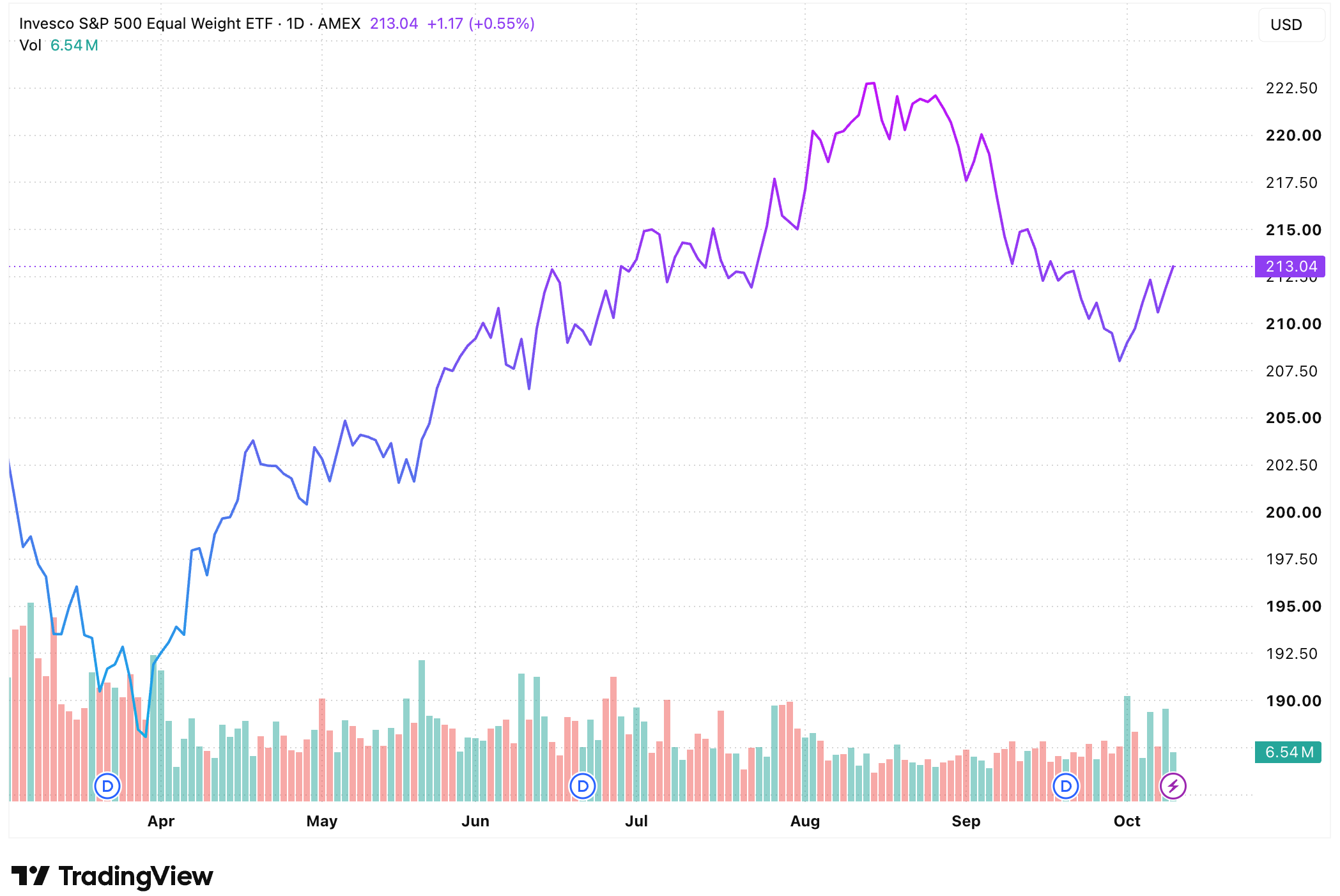
On October 8, however, the Financial Times reported that OpenAI's annualized revenue was running near $50 billion — roughly $20 billion below earlier reports — and the Nasdaq slid 1.25%, its worst day since mid-August (Source: CNN, Tech stocks drop after report that OpenAI's revenue is lower than expected). For the week, semiconductors dragged on tech, with Intel down 12.3% and Lam Research down 8.2%, while utilities (+4.0%), consumer staples and energy (+3.6% each) and financials (+2.3%) carried the index. The key signal: the equal-weight S&P 500 rose 1.6%, outpacing its cap-weighted counterpart (Source: Atrani Capital, Week #41 — Market Update for October 5-9, 2026).
The data tilted toward inflation. The September ISM services PMI eased to 54.9, but its prices index jumped to 74.0, the highest in about four years (Source: PR Newswire, Services PMI® at 54.9%; September 2026 ISM® Services PMI® Report). Minutes of the September FOMC meeting, released October 7, showed most officials saw another hike as likely appropriate by year-end (Source: Federal Reserve, FOMC Minutes, September 15-16, 2026). Even so, CME FedWatch odds of an October hike fell further, to 17.7% from 22.1% (Source: Atrani Capital, same article).
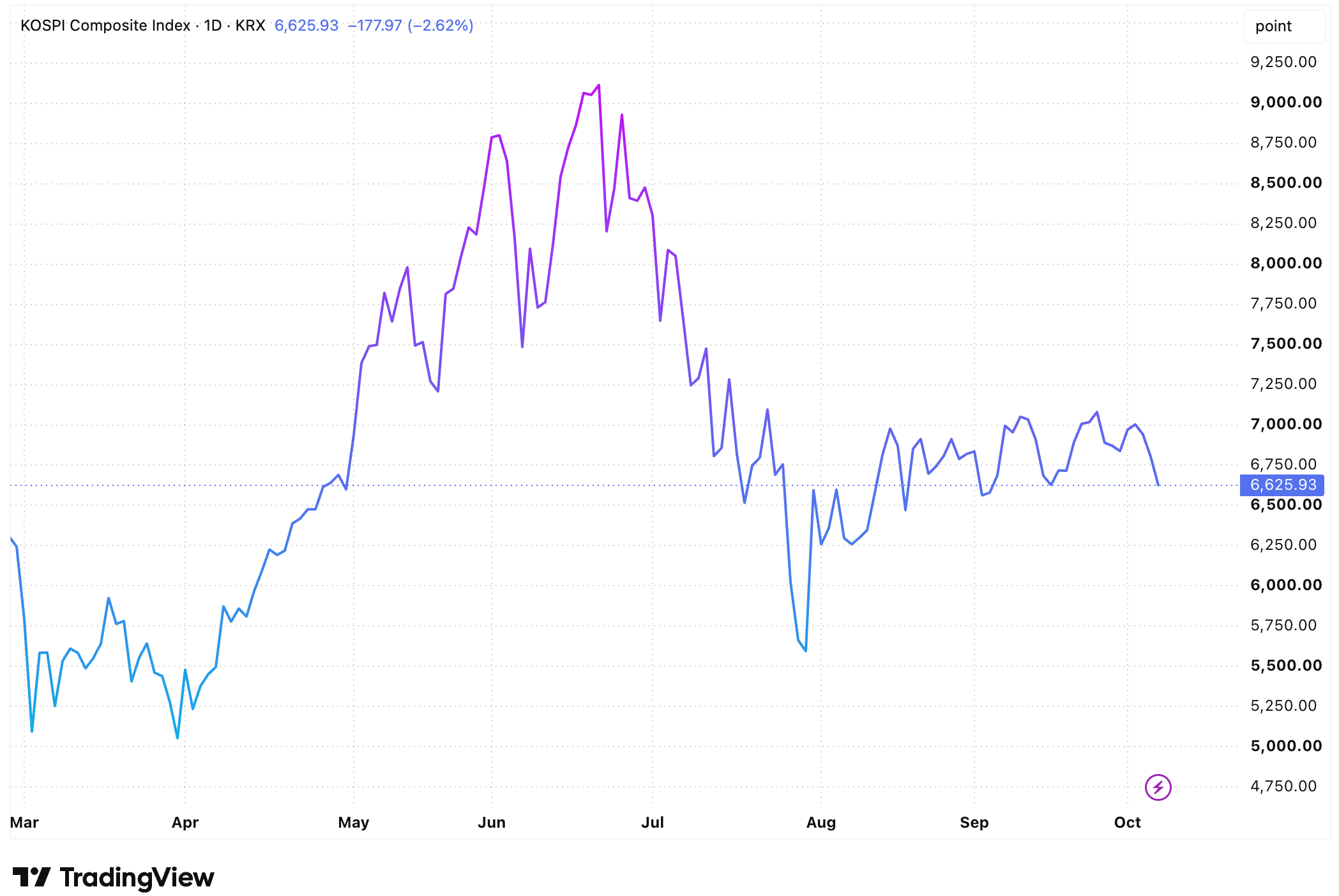
Korea moved the other way. The KOSPI fell for three straight sessions — to 6,941.39 on October 6 (-0.89%), 6,803.90 on October 7 (-1.98%) and 6,625.93 on October 8 (-2.62%) — for a weekly loss of 5.39% (Source: Money Today, Oct. 6 close and Oct. 7 close; Financial News, KOSPI slides to 6,600; chip earnings in focus). On October 8, Samsung Electronics reported preliminary Q3 revenue of 195 trillion won and operating profit of 107.4 trillion won. Foreign investors nonetheless sold a net 2.44 trillion won of KOSPI shares that day (including the Nextrade alternative exchange), and Samsung's stock fell 2.42% to 262,000 won (Source: Newspim, KOSPI falls 2.6% to 6,625.93 despite Samsung's ₩107 trillion profit). The tech-heavy KOSDAQ held up better, slipping just 0.11% from 893.29 to 892.27 (Source: Newspim, same article). Korean markets were closed October 9 for Hangul Day.
Technical Analysis
The S&P 500 retested the 7,800 level during the week and closed just below its record (Source: TheStreet, Stock Market Today (Oct. 9, 2026)). First support sits near 7,650, where the 50-day moving average ran as of the prior week (7,657.66), with resistance in the low 7,800s near the record high (50-day source: Advisor Perspectives, S&P 500 Snapshot: Stocks Rally to Close Out Flat Week).
Bonds remain the swing factor. The 10-year yield touched 5.364% intraday on October 7, its highest since 2002 (Source: Korea Daily, US Long-Term Treasury Yields Surge — Term Premium Hits 12-Year High), before solid demand at the 10-year auction (2.77 bid-to-cover) helped it settle at 5.24% on October 9 — 4 basis points below the prior week's 5.28% (Closing source: U.S. Treasury, Daily Treasury Par Yield Curve Rates). The 10-year term premium, however, approached 1 percentage point, a 12-year high (Source: Korea Daily, same article).
The VIX eased from 15.31 to 14.84, and the Fear & Greed Index climbed from 31 to 45, its first "neutral" reading since late August, though its market-breadth component remains in "extreme fear" (Source: Yahoo Finance quote board, article above; Atrani Capital, same article).
In oil, Iranian tanker attacks and a Gulf of Mexico hurricane sent WTI up 3.6% on October 8 (Source: CNBC, Oil prices jump as Iran steps up tanker attacks). Prices calmed after President Trump said the U.S. would not strike Iran before the midterms, and WTI settled at $91.85, up about 0.8% on the week (Source: Business Recorder, Oil prices settle higher).
This week, September CPI and earnings from the big banks and TSMC will test the strength of the broadening rally.
U.S. bond markets are closed Monday, October 12, for Columbus Day, while stocks trade as usual (Source: Investopedia via Yahoo Finance, article above). Third-quarter bank earnings kick off October 13 with JPMorgan, Goldman Sachs, Citigroup and Wells Fargo (Source: TradingKey, The Week Ahead: US September CPI and PPI Set for Release). September CPI follows on October 14, with consensus calling for headline inflation of 3.6% year over year (from 3.4%) and core up 0.2% month over month (from 0.3%) — an energy-driven headline rise against a cooling core. PPI and retail sales land together on October 15, followed that evening by remarks from Fed Chair Kevin Warsh (Source: investingLive, Week ahead: US inflation and retail sales lead a busy economic calendar). TSMC's results on October 15 will be the first major read on AI demand since the OpenAI shock. In Korea, the end of roughly 55 trillion won in share buybacks at Samsung Electronics and SK Hynix leaves a potential gap in demand for the two chip giants (Source: Financial News, article above).
▲ Upside Scenario
If core CPI meets the 0.2% consensus and bank earnings hold up, the 10-year could stabilize around 5.2%, extending the rotation into financials and cyclicals. Confirmation of resilient AI demand from TSMC would also open room for a technical rebound in the KOSPI after its outsized chip-driven decline.
▼ Downside Scenario
A core CPI beat on top of a hot headline could push the 10-year back into the 5.3% range and pull forward expectations for a December hike. Rate pressure combined with renewed doubts about AI valuations would likely weigh again on chip-heavy markets such as Korea and Taiwan.
Positioning Implications
Last week's lesson is that what moved inside the index mattered more than where the index went. Investors may want to review concentrated exposure to a handful of AI mega-caps and quantify how diversified their sector and style mix really is.
Key Charts
Fig 1: KOSPI — 7,003.74 → 6,625.93, Down 5.39% in Three Sessions Despite Samsung's ₩107 Trillion Profit
source: tradingview.com
Fig 2: Equal-Weight S&P 500 (RSP) — A Broader Rally Outpaces the Cap-Weighted Index
source: tradingview.com
Investment Theme Spotlight
When the Rally Broadens — Equal Weighting and Financials
When AI mega-caps lose their grip on leadership, what drives the index matters as much as where it goes.
Nine of the S&P 500's eleven sectors rose last week, and the equal-weight index beat the cap-weighted benchmark by roughly 0.45 percentage point (Source: Atrani Capital, same article). Financials stand out in this backdrop. As of Treasury's October 9 closes, the spread between the 2-year (4.80%) and 10-year (5.24%) was 44 basis points, and the gap between the 10-year and 30-year (5.60%) was 36 basis points — a positively sloped curve (Source: U.S. Treasury, table above). That structure favors banks' net interest income, since they fund short and lend long. JPMorgan's third-quarter NII consensus stands at $26.84 billion, up from $24.07 billion a year earlier (Source: Zacks via Yahoo Finance, JPMorgan Chase & Co. (JPM) Q3 Earnings Preview).
Related ETFs/Stocks:
- RSP (Invesco S&P 500 Equal Weight ETF): Holds S&P 500 constituents in equal weights, reducing concentration in a handful of mega-caps. It tends to gain relative ground when rallies broaden.
- XLF (Financial Select Sector SPDR Fund): Tracks the S&P 500 financials sector and is the most direct read-through on this week's bank earnings. The sector gained 2.3% last week (Source: Atrani Capital, same article).
Risk Factors: With market breadth still in "extreme fear," the broadening could prove a short-lived bounce. A sharp jump in long-term yields would raise banks' unrealized bond losses and credit costs, and a fresh earnings-driven rally in AI mega-caps could leave equal-weight strategies lagging again.
Macro Dashboard
Key Changes Last Week
| Indicator | Level | Change | Takeaway |
|---|---|---|---|
| S&P 500 | 7,811.54 | 7,722.72 → 7,811.54 (+1.15%) | Record on Oct. 6; equal-weight +1.6% |
| Nasdaq Composite | 27,366.17 | 27,190.86 → 27,366.17 (+0.64%) | Fourth straight weekly gain; chips lagged |
| Dow Jones | 51,654.95 | 51,176.96 → 51,654.95 (+0.93%) | Defensives and financials led |
| KOSPI | 6,625.93 | 7,003.74 → 6,625.93 (-5.39%) | Three straight declines; heavy foreign selling |
| KOSDAQ | 892.27 | 893.29 → 892.27 (-0.11%) | Held up on chip-equipment names |
| U.S. 10-Year Treasury | 5.24% | 5.28% → 5.24% (-4 bp) | 5.364% intraday Oct. 7, a 24-year high |
| VIX | 14.84 | 15.31 → 14.84 | Equity volatility subdued |
| Fear & Greed | 45 (Neutral) | 31 → 45 | First neutral since late Aug.; breadth in extreme fear |
| WTI Crude | $91.85 | $91.11 → $91.85 (≈+0.8%) | Iran risk and hurricane vs. pledge to hold off strikes |
| USD/KRW | 1,338.50 | 1,350.60 → 1,338.50 (bank reference rate) | Won firmed despite KOSPI slide |
(USD/KRW source: SNM News, Oct. 8 won/dollar rate 1,338.50, bank reference rate basis)
Events to Watch This Week
✔︎ U.S. big-bank Q3 earnings (from Oct. 13): JPMorgan, Goldman Sachs, Citigroup and Wells Fargo — NII and loan-loss provisions will show whether the financials rally has legs
✔︎ U.S. September CPI (Oct. 14): Headline seen at 3.6%; whether core meets the 0.2% m/m consensus is key for long-term yields
✔︎ TSMC Q3 earnings, U.S. PPI and retail sales (Oct. 15): The first major AI-demand check since the OpenAI shock, plus remarks from Fed Chair Warsh
✔︎ End of Samsung Electronics and SK Hynix buybacks (this week): With roughly 55 trillion won of buying gone, foreign and institutional flows may hit the KOSPI more directly
※ This article was written based on the analysis of generative AI.
※ This investment market report is prepared for informational purposes only and should not be interpreted as a solicitation to buy or sell any specific investment product or as investment advice. The final investment decision and the resulting liability rest solely with the investor.


